Category Archives: design

Longing for a library

Some dreams start early on. My dream was about books.

I grew up with books. My parents had a whole wall of shelves filled with books in each of the the two houses we grew up in. To this day my parents still have a book collection that fills a whole wall in their living room.

I always owned a lot of books, and with Cathy’s and my combined collections we can call ourselves the proud owners of a small library. For me, books make a home complete.

Back in 2009 when we bought our building, I walked into the 1st floor front parlor, looked at that large blank wall and had a vision: a wall of books. We fairly quickly began to refer to the front parlor as the library.

I looked at and measured that wall countless times as I developed the concept of built-in shelves that would liberate our book collection from their hidden existence in cardboard boxes and render them once again freely accessible.

Having the concept of built-in shelves at hand during our deep energy retrofit was very helpful and informed the remodeling process.

The shelves would sit along an exterior wall, which was also slated to accommodate a baseboard radiator. Because I did not want the radiator to end up behind the shelves, I framed out the bottom of the wall so that we could mount it in the same vertical plane as the front of the built-in shelves.

During one of my excursions to The Rebuilding Exchange, I scored an antique front panel of an old hutch with beautiful and functional doors that have the old drawn or rolled glass. I easily integrated this piece into the concept and it made for a beautiful addition to the planned shelves.

Related posts:

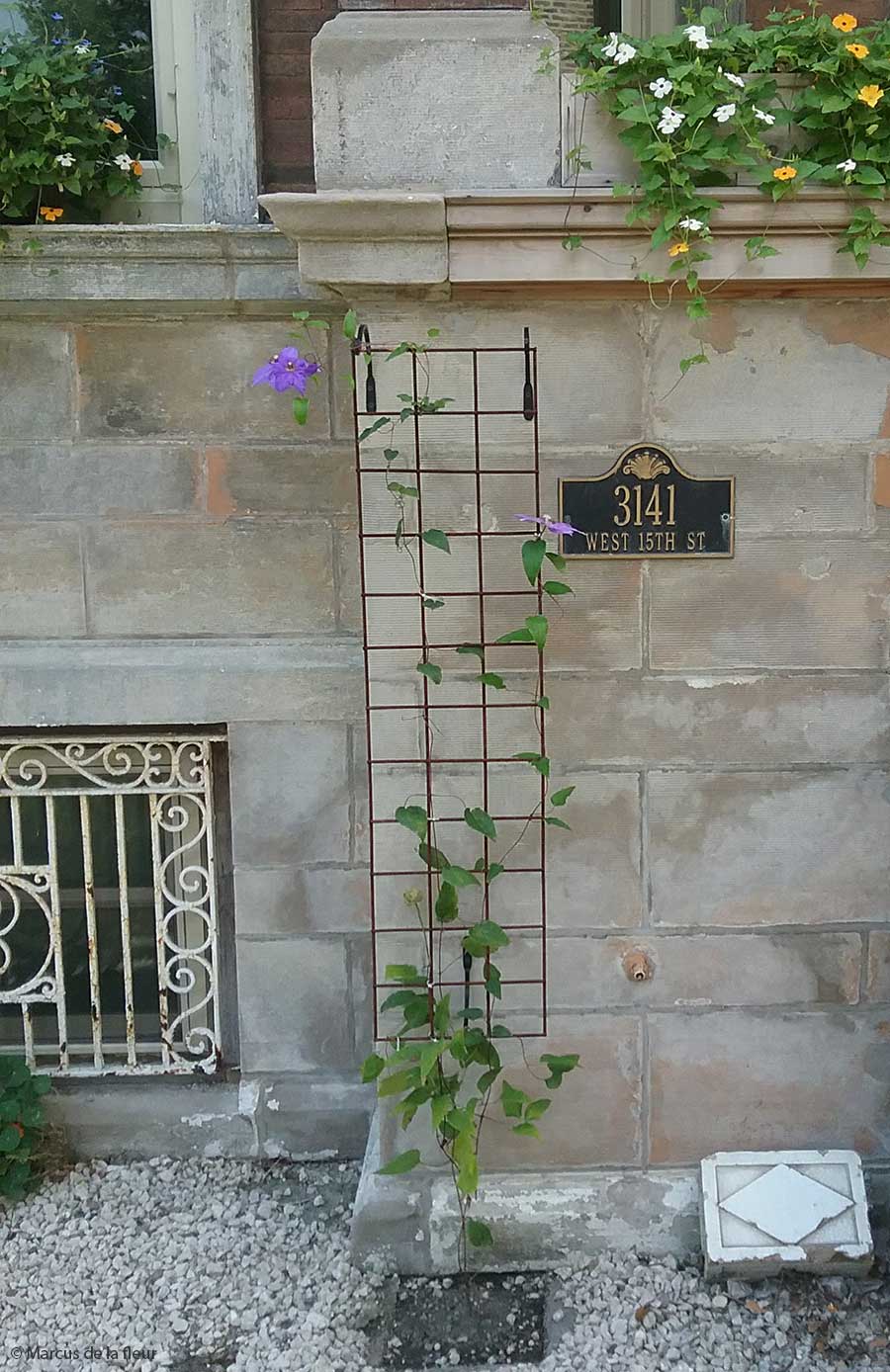
About clematis, ruins, and architecture

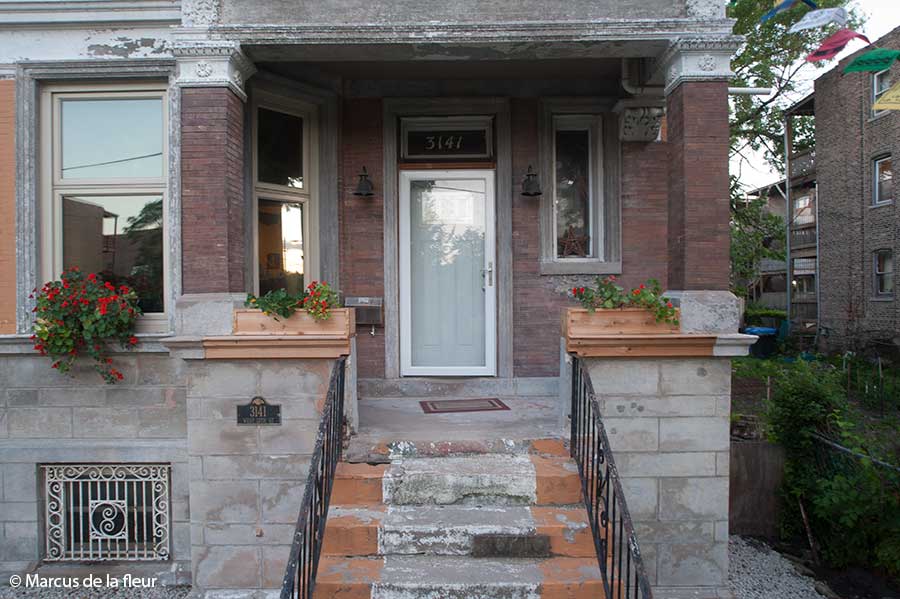
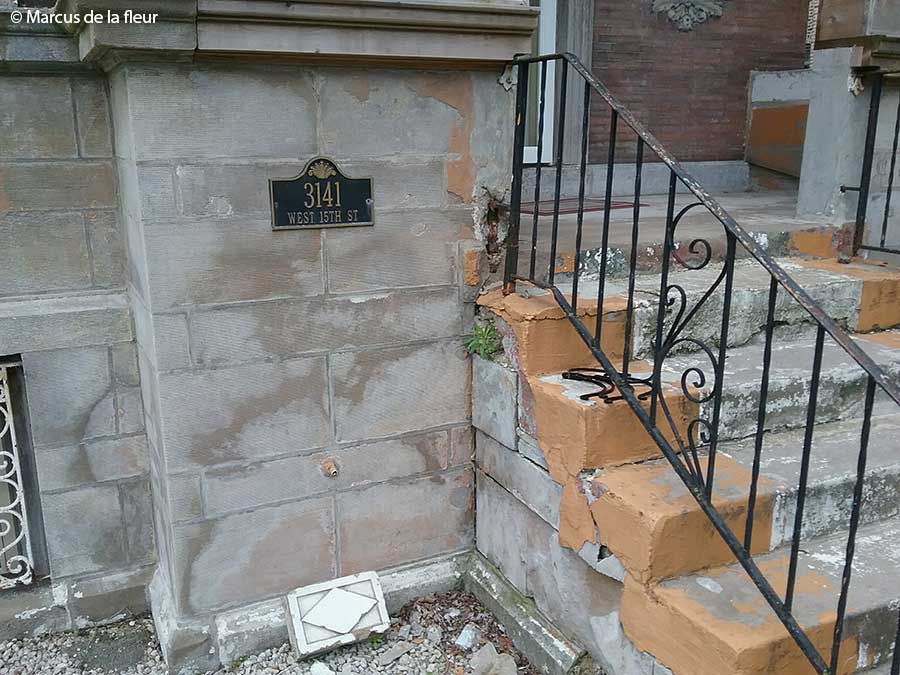
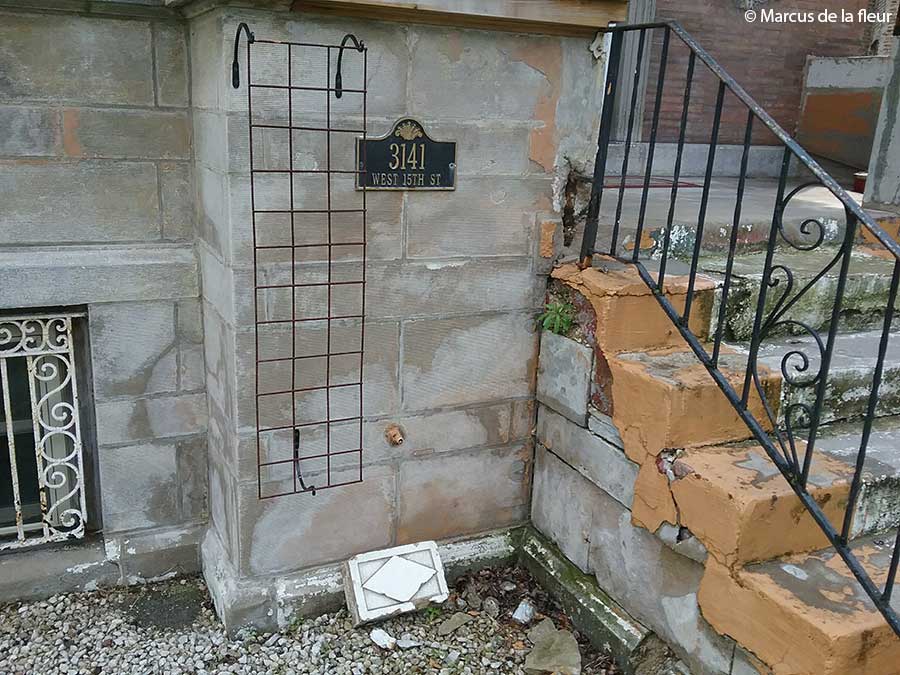
Majestic front porches are a typical staple of beautiful graystone and pseudo-graystone buildings like ours. This architectural feature from the era around 1900 crowns most front doors in our neighborhood.

Yet it is a static and somewhat lifeless element — that is, it only appears to change with the light of the day and season. In that way it’s similar to a beautifully carved and weathering gravestone.

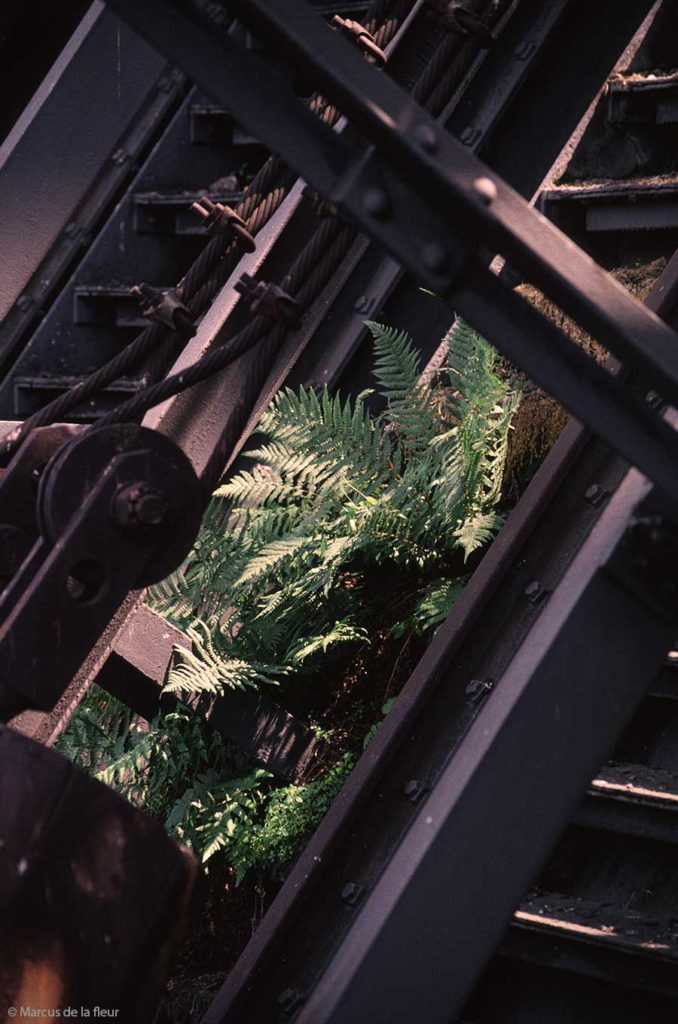
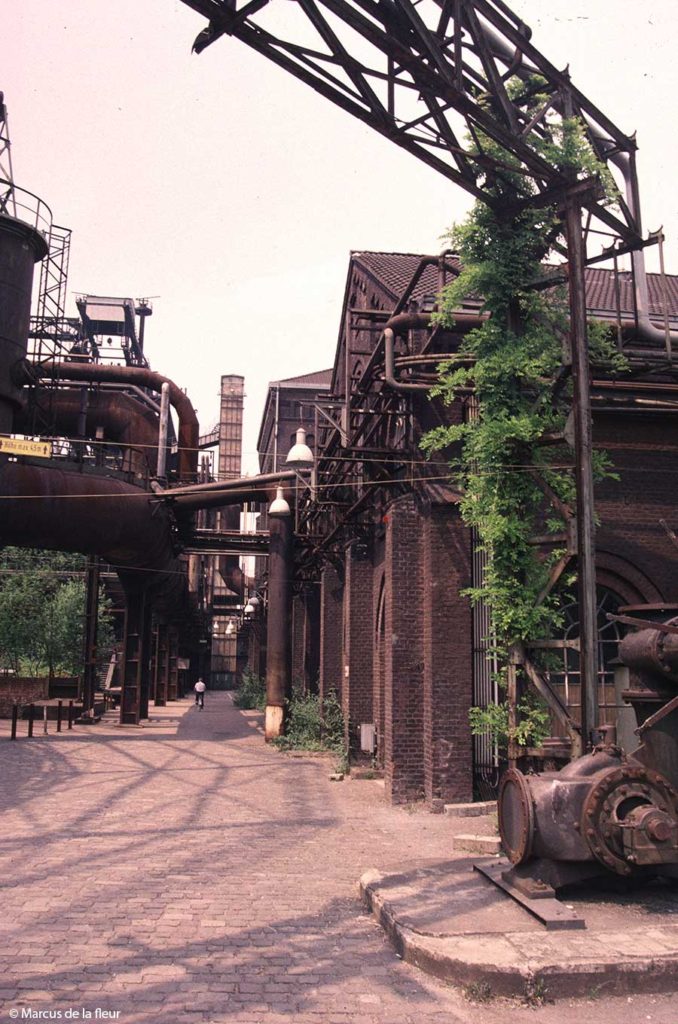
Sometimes inanimate architecture is invaded with life. And ironically, this rejuvenation is often observed when the actual structure is in the process of decomposition. Think of ruins, abandoned houses or farms, and retired industrial complexes, where a squatter by the name of Nature moves back in when no one is looking.

The contrast can be stunning between the proud man-made forms and lines that speak of control and hubris, versus the volunteering verdure, with its persistence, perseverance, and resilience that designers dream of, if only it would not be so unrestrained.

The impulse of controlling vegetation is at least as a old as farming itself. And even though it looks like a cage for a climber, I just try to lend a helping hand, because the obituary of this architectural artifact has not yet been written. (This applies more to our front porch, upon closer scrutiny, and less so to the stairs, which are due to be replaced.)

What if we can find a balance in which we embrace vegetational vivacity and let it harbor on our structures before they turn into relics? And instead of feeling threatened by its independent temperament, we can begin to laud its liveliness and ostensibly endless network of interconnectivity.

Dare I suggest that the ever changing, climbing, ranking, and rambling can, on occasion, improve the architectural form, and with it our quality of life?

Just sayin’.

Related posts:

Rain garden review

The reports of emerging spring ephemerals in Germany and colorful Camellias in Madeira are hard to ignore. Contrast that with the recent blast of arctic air that rolled over us here in Chicago. Our rain garden is still in deep hibernation and blooming spring ephemerals still seem somewhere in the distant future.

What I have at my disposal is a trip down memory lane, to stretch that little bit of sanity that is left until we are finally blessed with the elusive spring warm up.

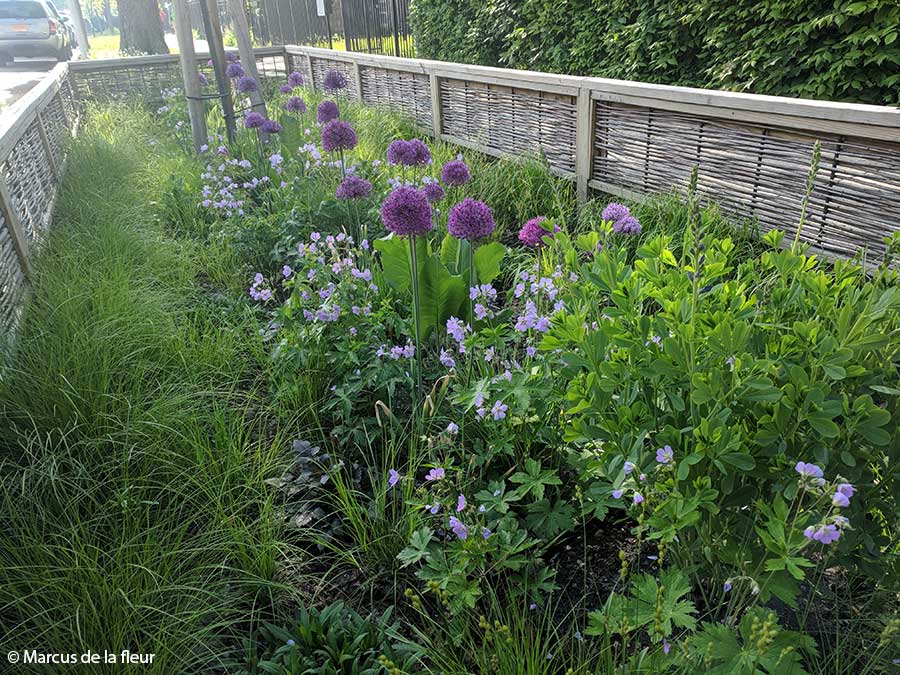
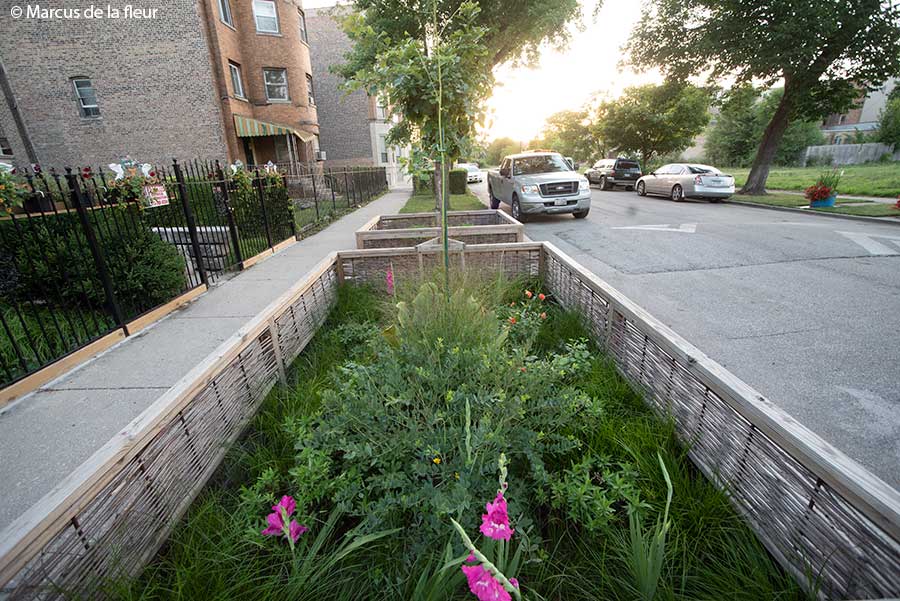
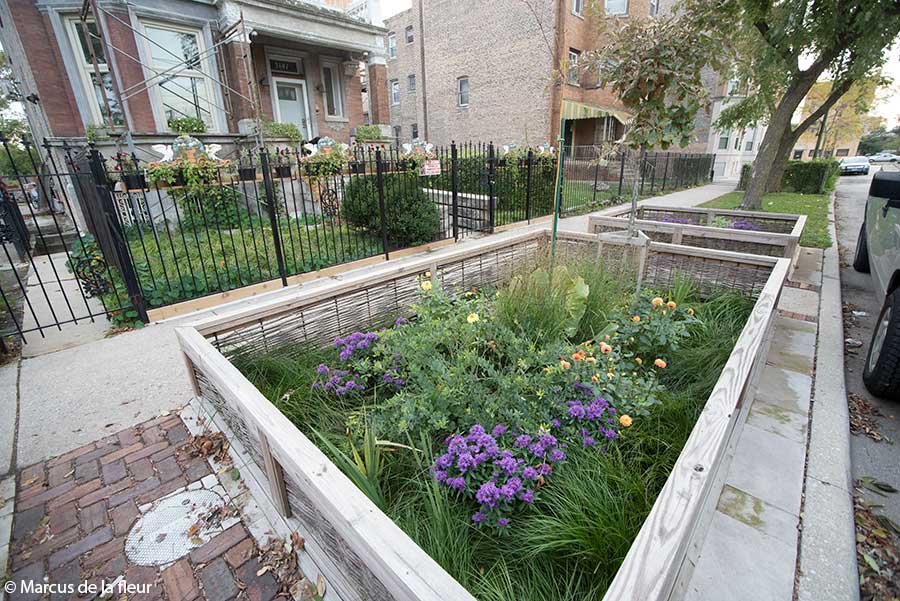
I wrote about the timid progress on our parkway rain garden during the 2017 season. It took until late summer before we got some substantial growth. The 2018 growing season in contrast was significantly more productive and richer in diversity, colors and textures.

I have mentioned before that we have two schools down the street from us. Once school lets out, we have kids flying down the street with an impressive amount of raw and wild energy. It reminds me a lot of my younger self and the extraordinary resilience of my parents!

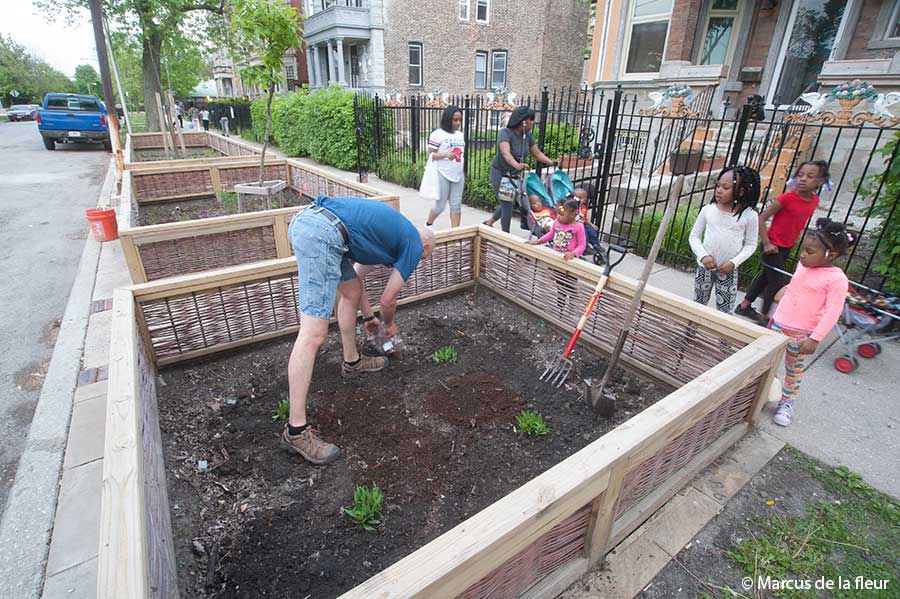
If it wasn’t for the fence, the rain garden would have been bulldozed many times over by the sheer volume of little feet. But even the fence is sometimes not enough of a signal or barrier.

When I perched myself on our front porch just before the end of the school day, I could catch the pairs of feet that prefer running across sedges and asters versus the concrete sidewalk.

I was often amused by the interaction that pursued: It starts with the big eyes of someone that got caught. I strike up a conversation. I ask questions. I share a few facts about a plant or a flower, but I don’t lecture. Usually at this point I get the “deer in the headlights” stare. The little mind behind the eyes is racing, trying to process why they are not getting yelled at.

Aspects of our conversation appear to stick. At a minimum, the minds that are connected to the little feet remember our exchange for the next few weeks. One step up from the minimum would be if I left an impression and generated curiosity about the rain garden. And in the best case scenario, I got through to the little minds and created allies. Allies that start telling off their friends the moment they try to climb the knee fence.

Gardening is not just for the soul or mind, it is community.

Related posts:

Blooming winter blues

The winter blues are setting in … a perfect time to think about gardening and write about design.

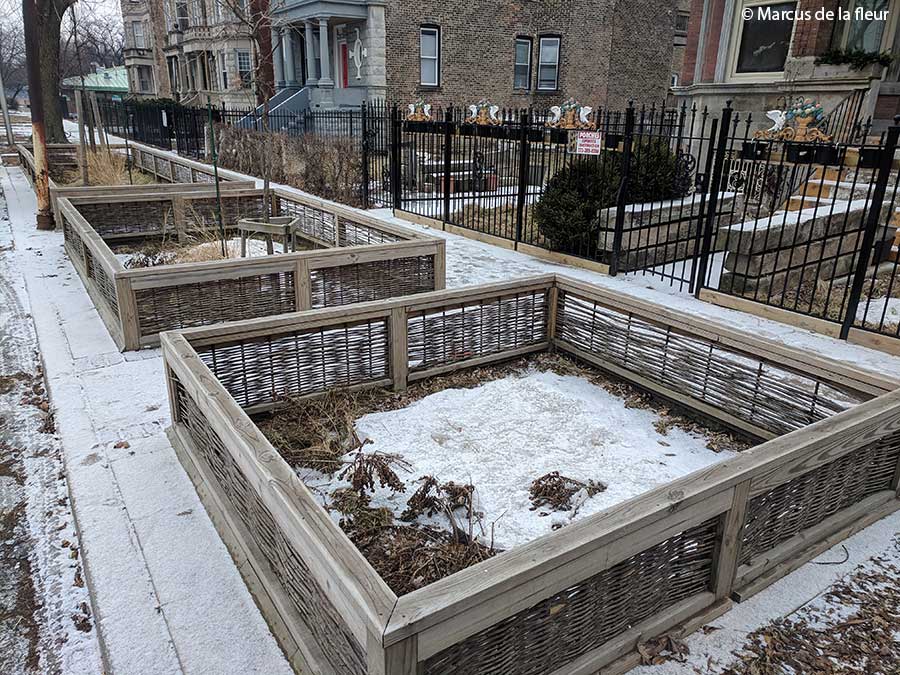
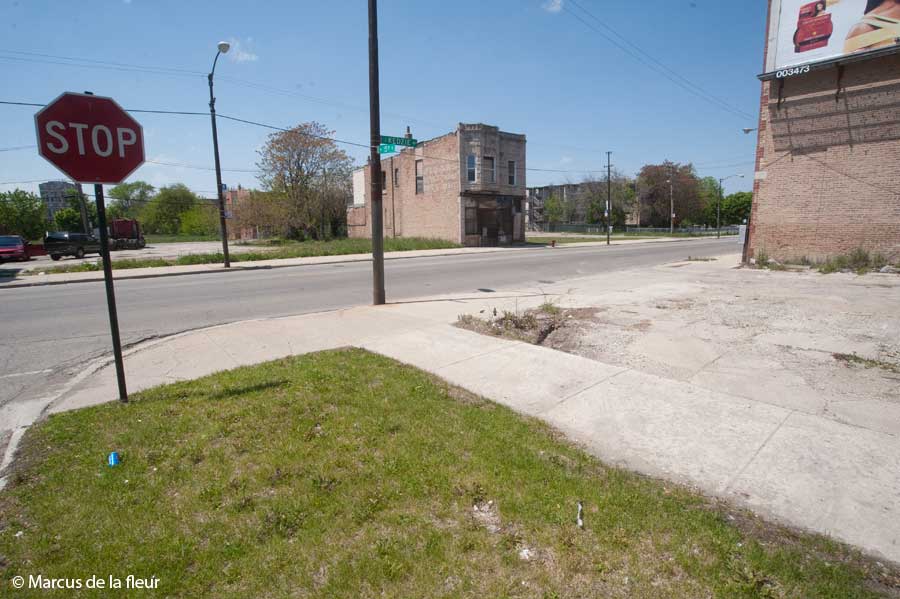
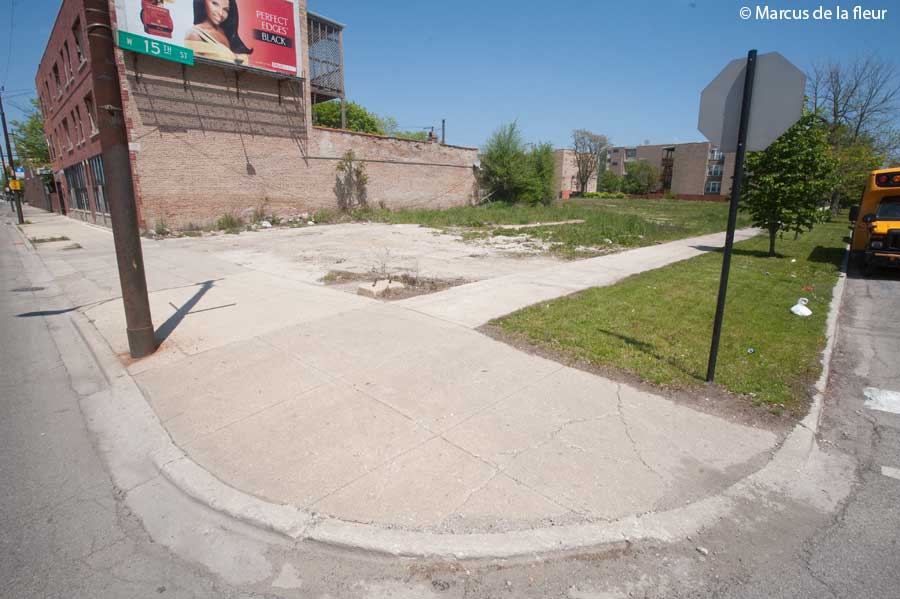
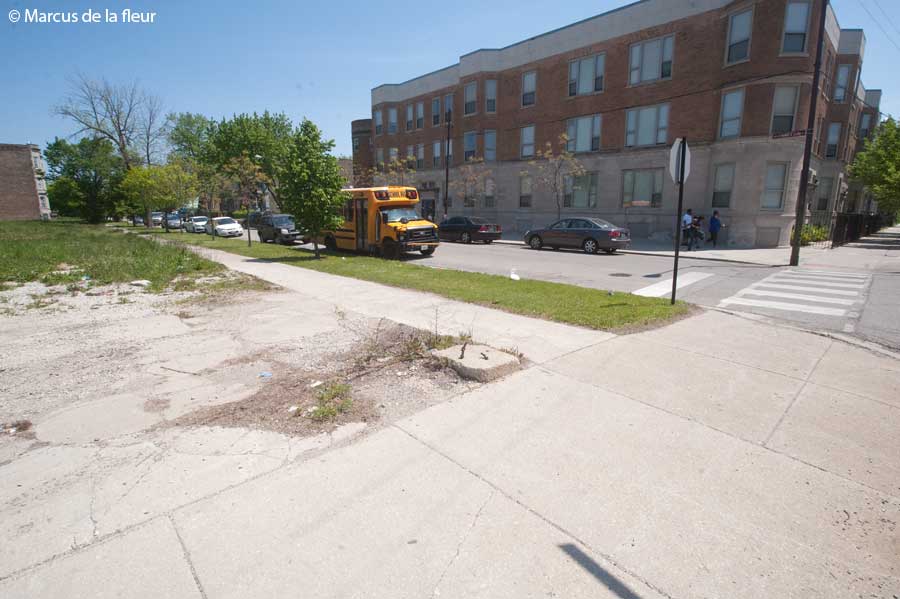
After the rain garden installation, I was interested in extending the display of care and pride towards the end of our block – the corner of Kedzie and 15th Street.

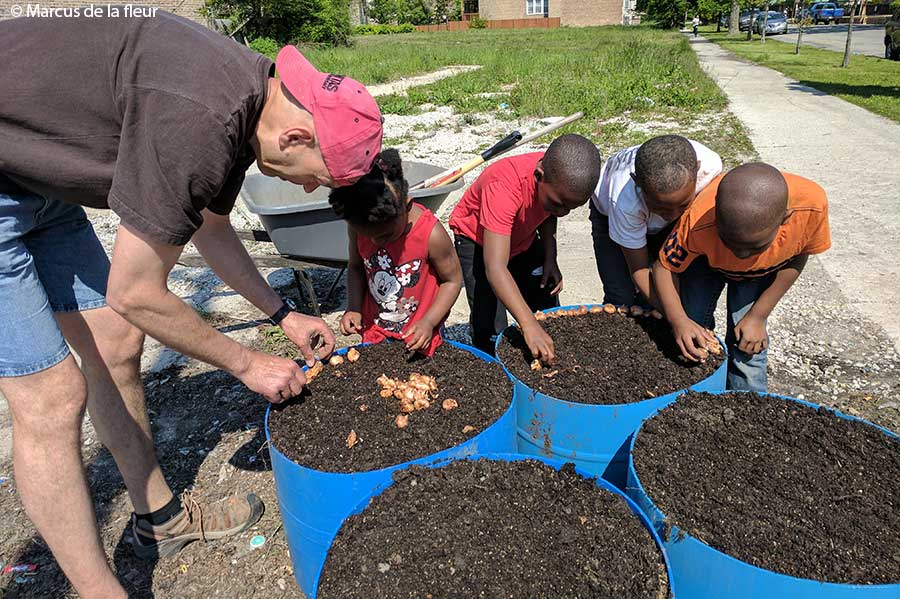
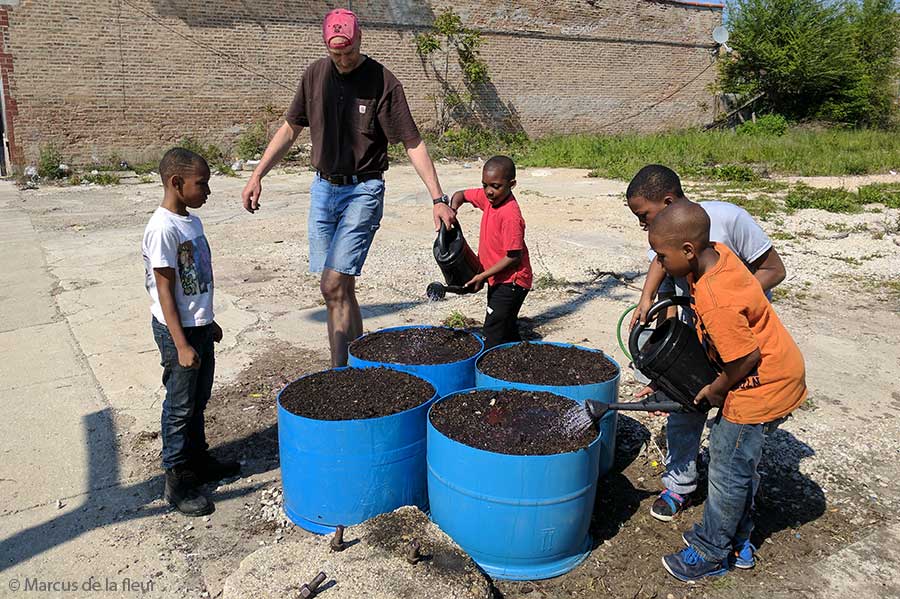
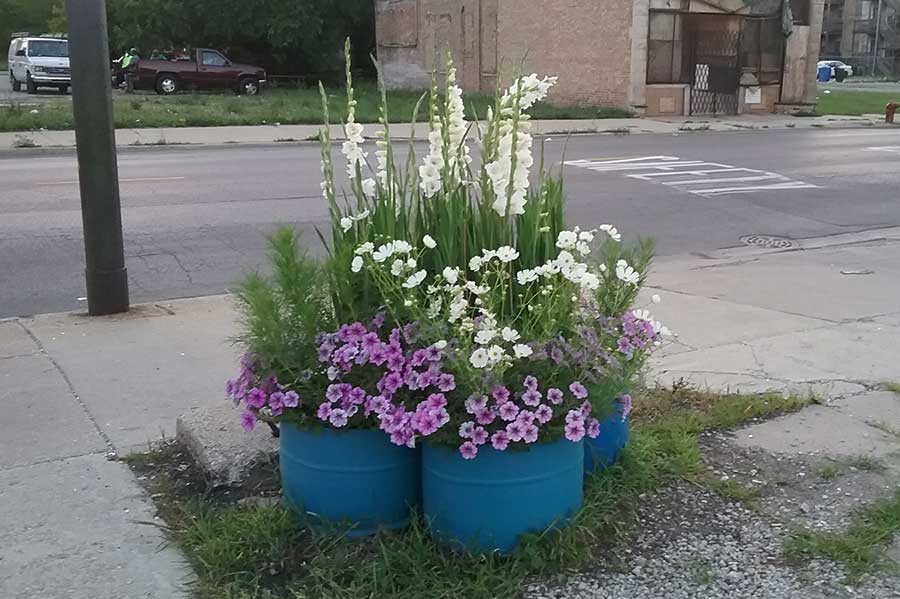
The pictures are a little misleading: This corner typically doesn’t look this clean. And because it tends to accumulate trash, and is the gateway into our street, I thought this would be the perfect spot to beautify by installing planters filled with annuals.

To assure the longevity of the planters and their contents, I needed some allies. And I found them in the kids on our block and adjacent blocks, most of whom attend the school just down the street.

Someone more cynical may have perceived the kids – or for that matter anyone – as potential vandals, and wouldn’t even embark on a project like this. Or they may have tried to safeguard it so thoroughly that there was nothing stimulating or enjoyable left.

The shadow of potential vandalism follows us designers on any public project. It often influences the design language. In an attempt to shield the end product, “care and pride” is sacrificed to  what could be interpreted as “we don’t trust you.” This does not foster a sense of community ownership, which starts the downward spiral.

The strategy adjustment that can correct this is fairly simple. Catherine Baker from Landon Bone Baker Architects summed it up in one beautiful sentence in an Chicago Tribune article:

“We assume the best of the neighborhood, not the worst of the neighborhood, when we design.”

I have to say that this strategy was more successful than some of my plant choices. At the end of the day, we were able to get the planters into a shape that clearly communicated care and pride, right at the gateway to our block.

Related posts:

Pondering plants and placement

As a landscape architect, I take pleasure in thinking through the meaning, limitations, structure, seasonality, texture, color, and composition of plantings that I work on. My rain garden in our parkway is no exception.

I had a couple of years to think about this and began to formalize my objectives over the winter months:

  • Don’t solve problems by throwing money at it. Design by being mindful about resources.
  • Rely on native plants that evolved to deal with our natural history and climate and thus provide resilience and longevity.
  • Select those native plants that would be suitable for a rain garden environment.
  • Develop a composition that could be reproduced in variations in other locations.
  • Aim for an end result that communicates care, value, and pride.
  • Keep the planting design simple enough so that it could be maintained without the knowledge of a master gardener.
  • Break some rules.

Why didn’t I mention color, texture or succession? Well, they are not objectives, they are
Prerequisites. And before I get too far along, let’s quickly talk about the big word: Nature.

I will be using native plants, but I’d like to think that I am humble enough to realize that I will not re-create nature or a prairie ecosystem. I intend to borrow from it and demonstrate how to use our native plants successfully in a horticultural context. But that is as far as I dare to aim.

With this framework in place, I could move on to the next one. Let’s call it the…

…Functional framework

To keep the rain garden functioning, I need to maintain the soil’s infiltration capacity – or, even better, improve it. The extensive and fibrous root systems of our native prairie grasses and sedges do just that.

Yet, my parkway doesn’t come close to the vastness of a prairie. And most prairie grasses are tall, which makes them a perfect fit for vast landscapes, but not for my molecular sized rain garden. To achieve a level of proportionality, I will have to rely on a groundcover matrix of sedge species that are smaller, more compact, and a better fit for the space. In this case, I will largely rely on Carex sprengelii (Long-beaked Sedge) and Carex vulpinoidea (Fox Sedge).
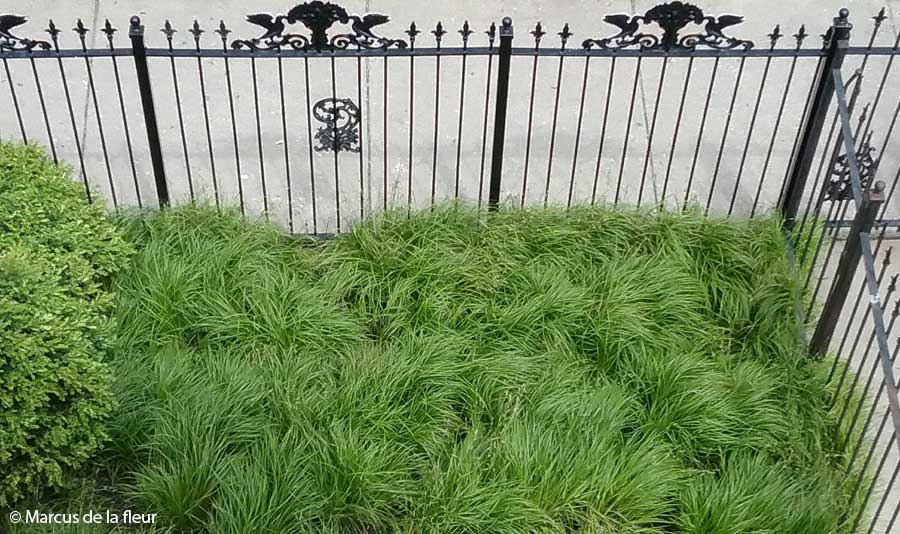
The sedges themselves would provide a stunning rain garden for most seasons. Still, I would like to add some structure, texture, contrast, and seasonality.

From color to contrast

Two Baptisa australis (Blue Wild Indigo) that flank the path at the side yard gate will add structure, along with two Amsonia hubrichtii (Blue Star) in the east end and one more at the west end of the parkway landscape. A number of Panicum virgatum ‘Shenandoah’ (Switchgrass) that are spaced between the Baptisia and Amsonia will continue the layering of heights. Yet the upright Panicum will contrast with both, the round shaped Baptisia and Amsonia.
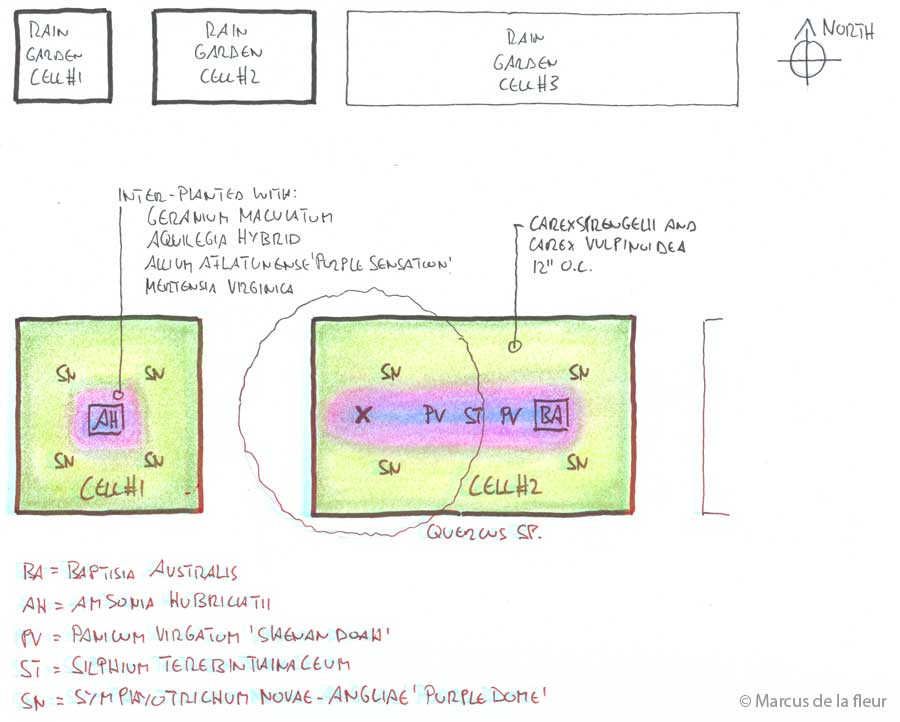
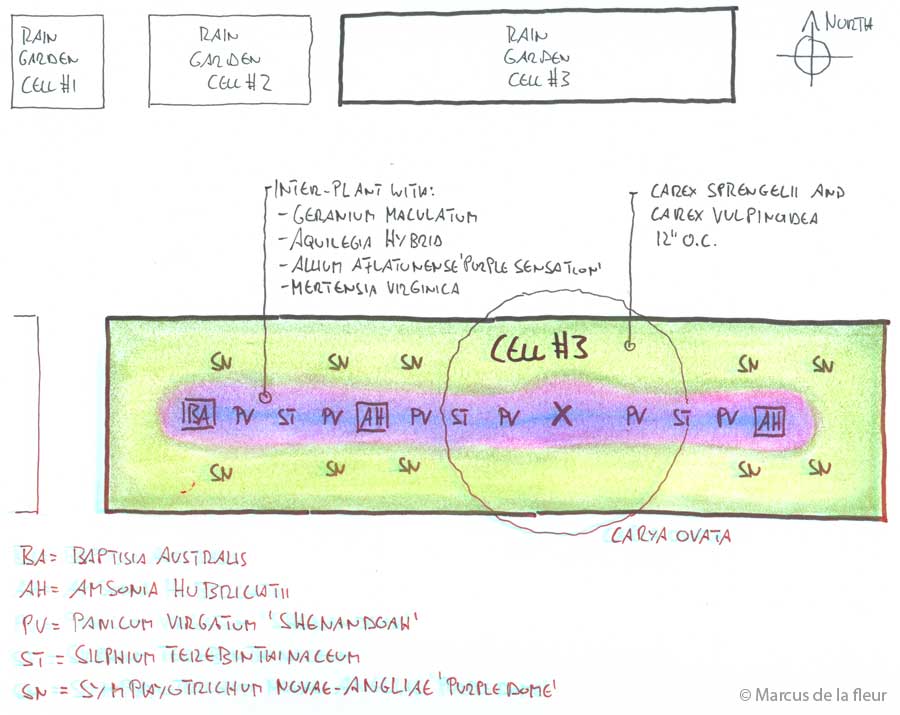
The flowering season is opened with Mertensia virginica (Virginia Bluebells), Geranium maculatum (Wild Geranium) and hybrid Aquilegia (Columbine). May and June would be dominated by the display from the Baptisia. The summer display may vary, because this is where I like to break the rules. Rather than relying on native perennials, I plan on using annuals, which may vary from year to year. This year I will start with a yellow-orange-red collection of hybrid Coreopsis and Dahlia.

Another rule breaker is the addition of two non-native geophytes: Daffodils and purple Alliums.

Autumn will be illuminated by the stunning fall colors of the Amsonia hubrichtii and Panicum virgatum ‘Shenandoah’. To complement the range of golden-red hues, I added Symphyotrichum novae-angliae ‘Purple Dome’ (New England Aster), with its purple flowers and yellow centers. (The purple flowers are actually bracts and the yellow center are the actual flowers).

Native plants have the stigma of delivering a wild and unruly look. That is not surprising considering that a considerable number of homeowners risk cardiac arrest upon the discovery of a clover leave in their lawn.

And this is why color composition, texture, and seasonality are important. They distract – or, even better – re-focus the observer’s attention. They create a new narrative that communicates care and intent, which is a juxtaposition to what is typically perceived as un-tame native plants.

While working with combinations of flower and fall colors is interesting, what really captivates me is textures and contrasts. Yet I can’t take credit for composition, because my inspirations came from stunning scenes I observed in Illinois’ and Wisconsin’s remnant prairies.

One such scene was the contrast between the superbly coarse texture of Silphium terebinthinaceum (Prairie Dock) splattered amongst a sea of delicately fine textured grasses, sedges, or rushes.
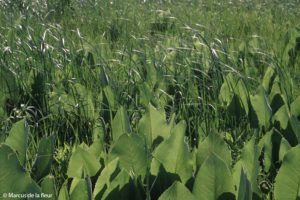
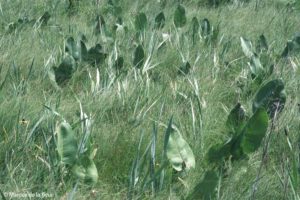
 

A scene that is picture-made for a garden environment, as it can be reproduced even at smaller scales.

The matrix of sedges and solitary Amsonia provide the beautiful yet delicate fine texture that is then interrupted four times by the majestic leaves of the Silphium. And yes, the Silphium has flowers that provide a spectacle on their own – but this is really about the contrast in texture, not the color or towering flowers.

The Silphium continues to draw the eye into the winter season, when its majestic leaves begin to curl and turn gray-brown with white speckles. The Panicum provides a remarkable contrast with its golden-reddish shafts against the pure white snow while the seed pods of the Baptisia with their blackish shell and silvery interior are reminiscent of elegant early 20th century black and white photography.
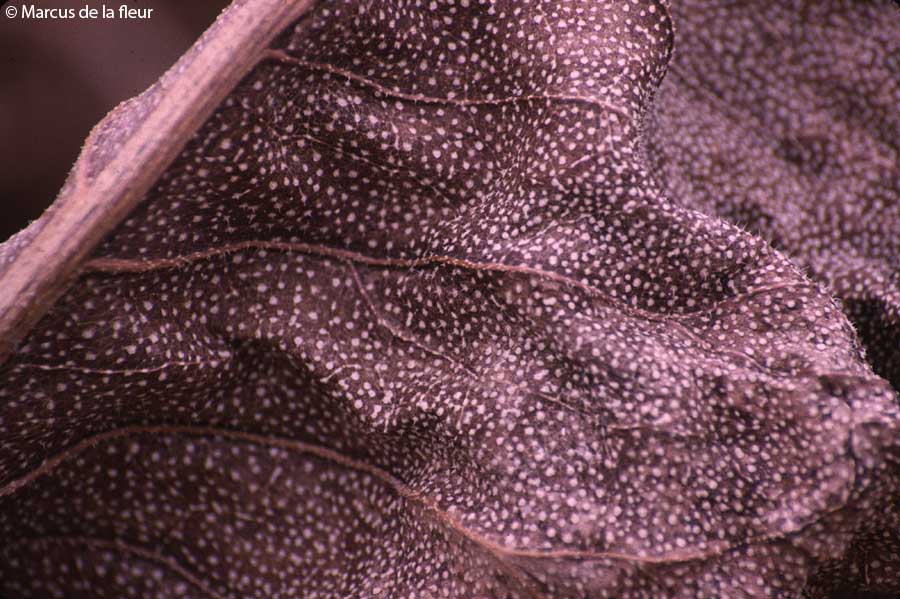
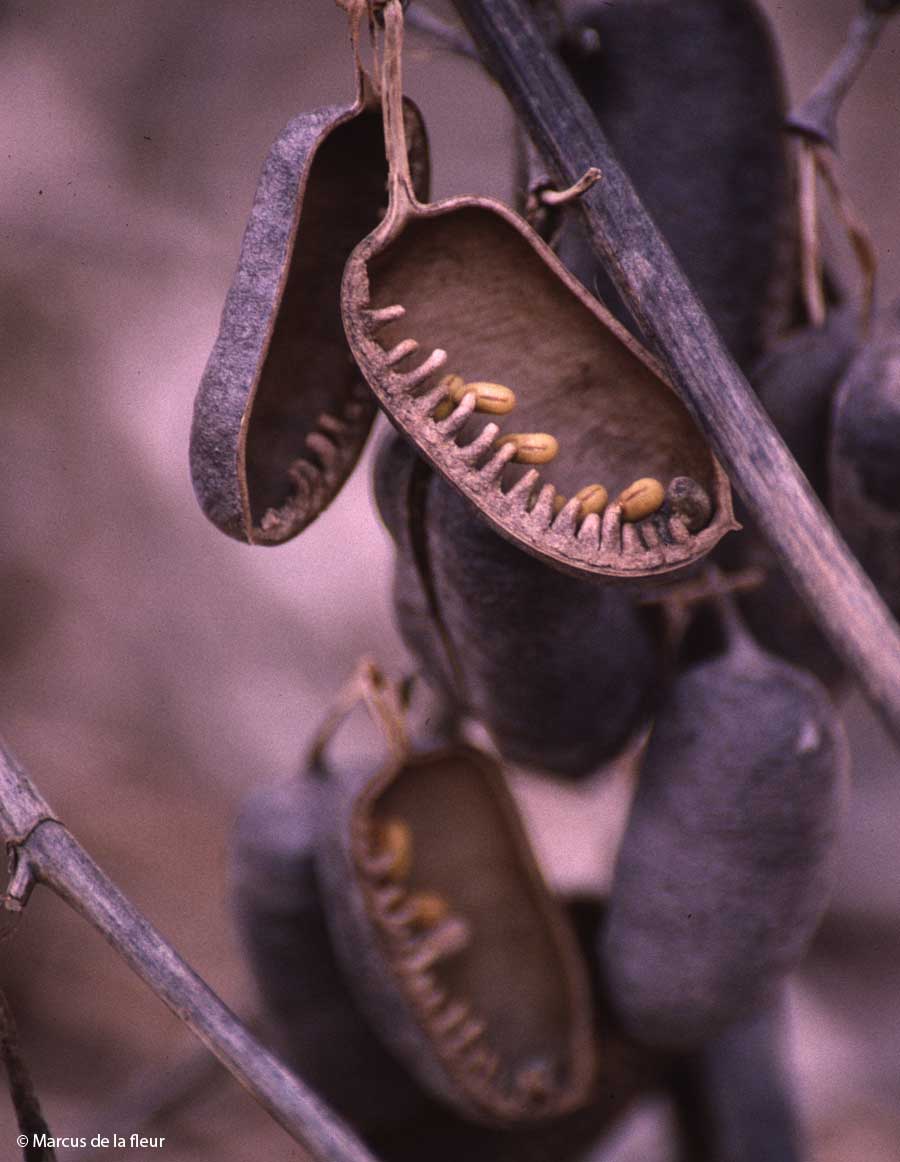
Committing to a native plant pallet in a design comes with its limitations. And that, as it turns out, can be a good thing. It’s something that keeps driving the creative process. Rather than getting bogged down by what a list of natives doesn’t provide, we begin to discover and explore their unique features and elements, whether it is the eye candy part or the functional element – managing stormwater.

Related posts: