The drywall is up and the radiators are installed. But we haven’t started with the taping and mudding of the drywall yet, for a very good reason.
I first wanted to pressure test the radiators. Should there be a leakage issue with the radiator connections behind the drywall, I would be able to attend to it by simply removing a section of wallboard. Once the drywall was taped and mudded, it wouldn’t that simple any more.
And by the way, this is just a precautionary measure. No one is expecting any leakage issues anyway.
To test the system I had to go into the utility room and put a pressure gauge onto the manifold servicing the 1st floor. I then pumped air into the system up to 40 psi and waited to see if the pressure dropped.
And yes, the pressure did drop! That was not the result I wanted or anticipated. Well, I think it is fair to say that I was in a state of panic.
We have hundreds of feet of PEX tubing running across the ceiling leading to the radiators in each room. How on earth was I going to find the leak?

After running around like a headless chicken for several hours, I decided to just step back, let it be, and come back the next day. That was probably one of the best decisions I made in weeks.
The next morning, the panic had given way to a more methodological approach – or a process of elimination:
I pressurized the whole system again, but then isolated each zone (i.e. each room) by shutting of the zone valve at the manifold. The result was that about half the zones did hold the pressure pretty well while the other half did not.
Which component in each zone could be the likely source of the leak?
The PEX tubing itself is so robust that it was very unlikely for it to be the cause of the leak. If it would be leaking, the pressure drop would probably be very rapid, which was not the case.

The one potential weak point in the PEX tubing is the crimp connection to the copper tubing. I tested a couple of these connections for leaks by spraying soapy water onto them. If there is a leak, soap bubbles will form. It turned out that the crimp connections were tight.
What about the soldered connections? Also very unlikely, unless I really messed up. I tested a number of soldered connections, which also showed no signs of leaking.

I never really trusted the unions and was convinced I was on the verge of solving the leakage problem. I tested every single union, and found only two with very minor leaks. That took me one step ahead, but miles away from having the problem solved.
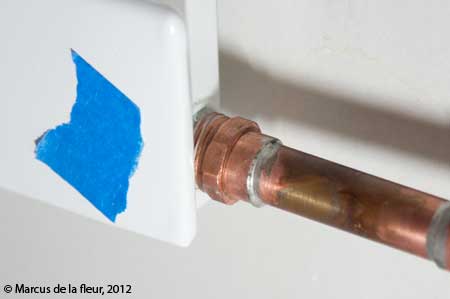
The last piece I hadn’t tested yet was the threaded connection to the radiator. Out again came the spray bottle with the soapy water, and lo and behold, I found plenty of leaks.

Imagine the sigh of relief! I reinstalled the connections with fresh Teflon tape and paste, tested them again and found them to be air tight.
Good news, right? Except I still had some level of pressure drop. I was flirting again with the state of panic. May be I had a leak in the PEX tubing hidden under the ceiling after all? What a nightmare!
I can’t recall how I got the idea (everything got a little fuzzy at that point), but I decided to spray the soap water solution onto the pressure gauge at the manifold in the utility room.

My eyes were bugging out! This little piece of s**t, this bloody small hunk of junk leaked at the valve! I must have been cursing non-stop on my way to the hardware store, where I bought a replacement. So came an end to this period of peak stress, after about two and a half days of frantic worrying on an emotional roller coaster.
I was so exhausted – but also so glad!
Yikes, so glad you got it figured out! Good job.
I should have mentioned that I had no experience in doing this. All I had was a bundle of raw nerves… I think an experienced installer would have solved this problem much more smoothly than I did. I certainly will now better when I am ready to tackle the 2nd floor!
Great – not only that you found the leak!
I just can not praise you enough for a)
the systematic approach: separating the whole system in smaller units, checking for weak connections, eliminating one possible cause after the other…
and b)
your delicate way of describing the whole operation – as so many times before – in a stile that enables even me to understand what you are doing.
how did you even sleep? at least it was air, not water.
Oliver – the systematic approach didn’t come easy, but after ours of panic… but it came 😉 I don’t think that I have a particular good way of describing things – but that your English skills are excellent!
Mark – exhausting was the insurance policy for sleep. But I still kept dreaming about the problem – at least a couple of times…