The feeling of accomplishment I earned with the flex connections in the library didn’t last. I took a look at it the next morning and thought: Hell no!
Here is the issue:
We had planned on a long built-in bookshelf, which led us to call this room the library. I couldn’t hide the radiator behind shelves, so I built out the shelf base onto which I could hang the radiator.
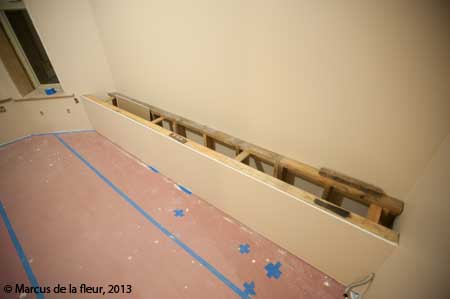
The stainless steel flex tubing at the return end of the radiator is routed into that base, where it connects to the copper tubing. That connection, hidden in the shelf base, raised a red flag.

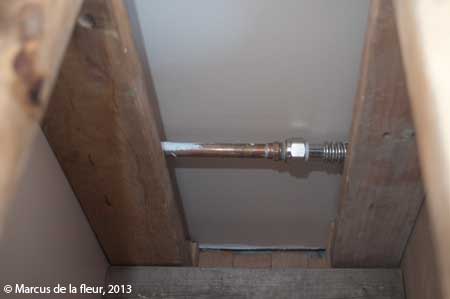
This connection will need servicing at some point. But how would I get to it? Don’t get me wrong. There surely is a way to get to it – there just isn’t a good or simple way. If I can prevent walls from being opened up in the future, I am enthusiastic in pursuing it.
This flex connection had to go and get replaced with hard piping. This way there is nothing in the shelf base that needs servicing.
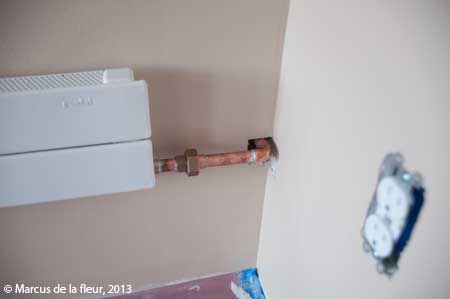
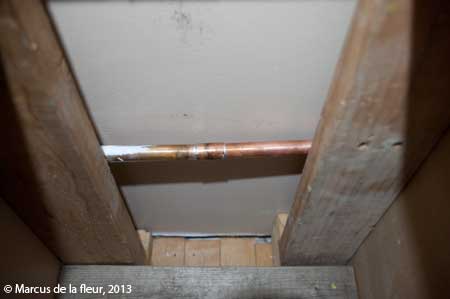
But wait! Didn’t I need the flex connection to absorb the radiator expansion? I did!
But I still have the flex connection at the supply side of the radiator. And that should be more than enough to absorb the radiator expansion.

Marcus, I will have to check more on the units involved…
1 °C equals 1 °F, but I need to learn more about you “start”-temperature. Your numbers are looking to be quite right to my metric eyes… I think that a flexible connection on one side should provide sufficient degree of freedom, depending on the radiator is fixed on the wall.
I don’t think that 1 °C equals 1 °F, but don’t know the conversion factor either. Start up temperature should be room temperature, or a little less, say 65°F (18°C). The radiators are not “fixed” on the wall. They sit/hang on brackets, and thus can slide left or right. If you look carefully at the installation videos in the previous posts, you may notice me attaching one of the bracket components to the wall. The second one is S-shaped and slides onto the radiator and the wall bracket. (http://runtalnorthamerica.com/commercial_institutional/type_rf_wall_mount.html)
No, of course you are right. 1 °C equals 1,8 °F – now I checked on the units and conversion, sorry I was a little to fast.
However, if the radiator is fixed at one end but flexibel on the other and hanging on brackets so it can slide you should be safe.