I had a frantic few weeks, working my way through the to-do-list in preparation for the spray polyurethane foam (SPF) installation. It was frantic for a number of reasons.
We had the opportunity to take advantage of a $1,750 insulation rebate, which was available through Energy Impact Illinois. This particular rebate period ended on August 21, 2013, which meant that I was under the gun to get everything ready and installed in the weeks prior.
Aside from the preparations, I had to decide how exactly we would insulate the 2nd floor perimeter walls.
Insulation assembly
The first floor walls had three rows of brick (three wythe), but narrowed down to two wythe on the second floor. That freed up an additional four inches in depth toward the interior, which allowed me to consider alternative insulation strategies compared to the 1st floor and garden unit.

The solution we came up with has roughly the same price tag as the 1st floor insulation, but an R-value close to 40 (compared to R-28 on the first floor)
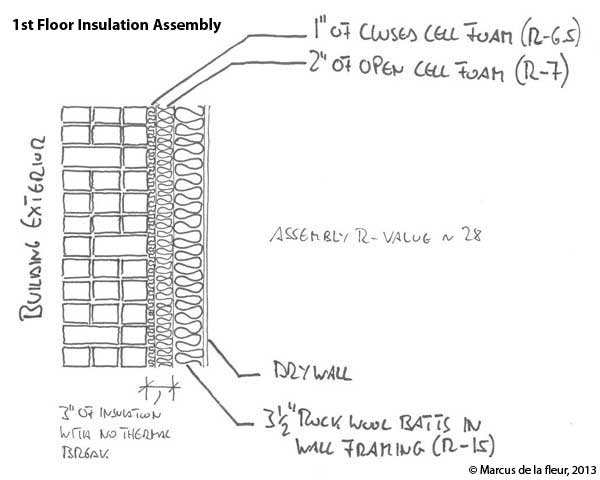

Two inches of closed cell SPF on the masonry wall will provide us the critical air sealing. It also exceeds the minimum recommended insulation depth to prevent moisture accumulation in the wall assembly. At two inches of SPF, the dew point during the winter months will be located mostly within the foam. This prevents condensation, or more precisely, the wetting of the interior wall assembly and potential for mold growth.
Following the two inches of closed cell foam, we will have a contiguous layer of 3 1/2 inch rock wool batts stuffed behind the interior wall framing. The wall framing itself will be filled with another layer of 3 1/2 inch rock wool batts.
The closed cell SPF has an R-value of 5.2 per inch, while the 3 1/2 inch rock wool batts are listed at R-15. With two inches of the closed cell foam and two layers of the rock wool batts, the total R-value for the insulation assembly comes in at R-40.4.
Vapor permeance
As always, the moment you think you are done is also the moment where it gets interesting.
Only a couple of years back, I had no concept of what vapor permeance is or means. This project gave me a shove and pushed me deep into this subject matter.
To assure the long term integrity of the masonry walls, I’ve had to maintain some level of drying potential, to the inside as well as to the outside of the building. That means I have been very picky about what closed cell foam product I’ve used. The higher the vapor permeance rate of the foam, the greater the drying potential into both directions.
Most closed cell foam products have a permanence rate of less than one at a depth of two inches. This would turn them into effective vapor retarders (Class II or Class I) and as such disqualifies them from this project.
I’ve had my eye on one product with 1.3 Perm at three inches (Class III vapor retarder). At the targeted spray depth of two inches, that permeance would be even higher and provided an acceptable drying potential. But I then I had to find a reasonably priced contractor that would offer to spray it.
This is where the story got really long and complicated. Maybe I should shorten it a little: We found that contractor.
Rebate requirements
The insulation rebate is not paid out in good faith, but is performance based. To qualify, a minimum energy reduction of 30% must be accomplished.
The verification of the energy reduction is a two step process.
- A qualified energy rater will conduct a blower door test before and after the insulation installation. The test will show to what extent the building envelope has been tightened up.
- The data from the blower door test and information about the insulation assembly will be used to model the projected energy reduction, which must fall at or below the required 30%.
What is that blower door test? And can we meet the 30% reduction? More about that in the next posts.
Hello Marcus,
Has the closed cell foam with 1.3 perm worked as expected? Have you had any issue with spalling on the exterior brick since installing?
I ask because I have a building that is very similar to yours (100 years old mass brick walls) in Logan Square. We’re planning now for a renovation, and I’m a little (or very) nervous about insulating the mass walls.
Best,
Jeff
Jeff, I would like to think that the closed cell foam with a high perm rate did work. I have some efflorescence showing up on occasion on the exterior brick work. But it is close to the ground and near exhausts with a high moisture load (i.e. dryer vent, range hood vent, etc.) If your primary goal for the closed cell foam is air sealing, you have other options, such as fluid-applied air and water-resistive barrier for masonry applications that are vapor permeable. That said, you still would need to address the risk of interior condensation on the cold brick wall.