Cabin fever season did peak during this years never ending winter! My preferred antidote was: Dream about spring and gardening. Or, as it is in my case – planting. Join me on a trip back to late spring last year when I was planting the three rain garden cells in our parkway.
I had put some thought into what I would plant and why. And at the end of the 2016 season I couldn’t resist putting the first perennials and geophytes into the ground.
In May of 2017, it was time to wrap up the rain garden planting. And I was prepared! I had pre-grown my sedges. My species of choice were Carex sprengelii (Long-beaked Sedge) and Carex vulpinoidea (Fox Sedge).
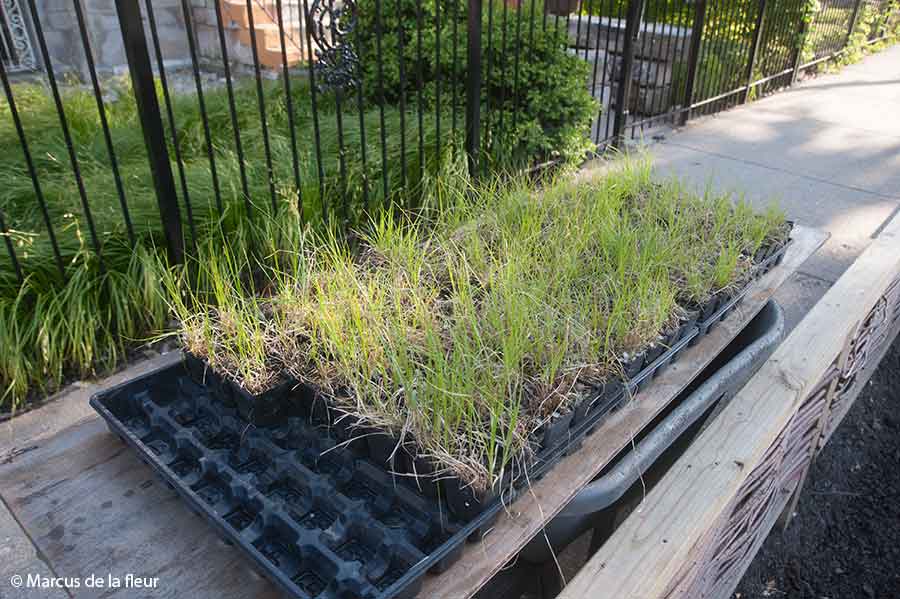
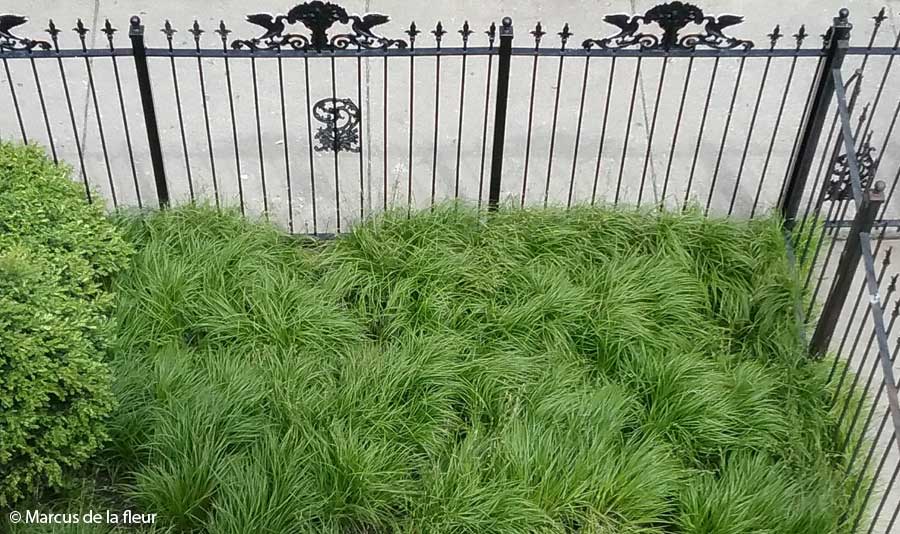
Not all our native sedges are suitable for a garden environment or tough enough to handle urban pressures. These two fellows (C. sprengelii and C. vulpinoidea) have turned out to be fairly resilient and have been strong performers in rain gardens. Not only that, but their beautiful fine textured foliage can only be described as eye candy.
Trapped in the plug sized trays, the sedges were screaming to be set free. Who can deny that request? If you’re a plant nerd, then you know what I am talking about.
I placed flags in the rain garden at the location of the structural perennials – as place holders – and planted the sedges at 12 inches on center across the rain garden. They provide the ground cover and act as the functional framework for the rain garden.
Also part of the ground cover matrix were two other species, Carex blanda (Common Wood Sedge) and Geranium maculatum (Wild Geranium).
I had a tray of pre-grown Carex blanda. As the common name suggests, this sedge can be found in our woodlands. This robust little fellow also does well in partial shade and partial sunny locations. I placed them at around the base of the Oak and Shagbark Hickory.
The Geranium maculatum came from a client of mine. She had them literally exploding in her rain garden and offered me the chance to harvest a bucket full of rhizomes.

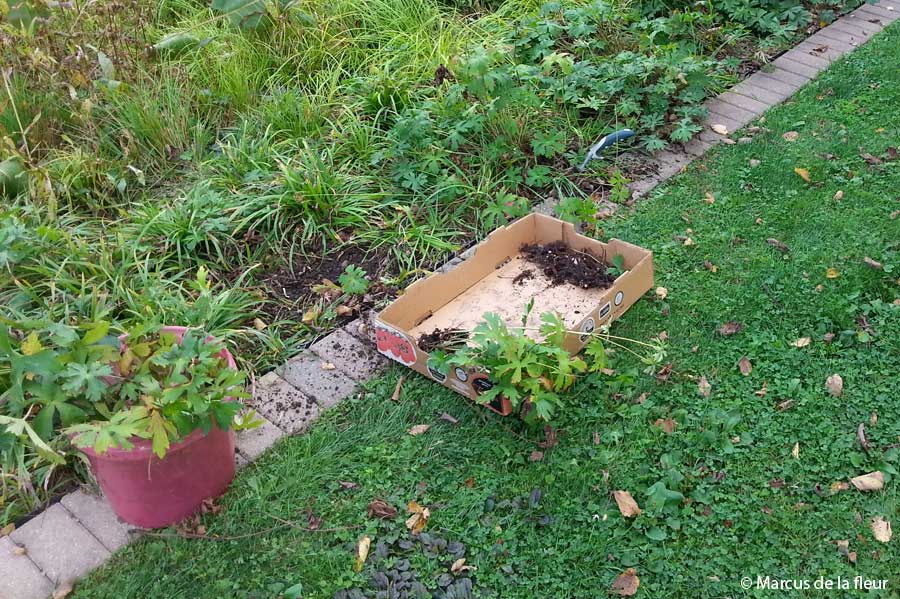
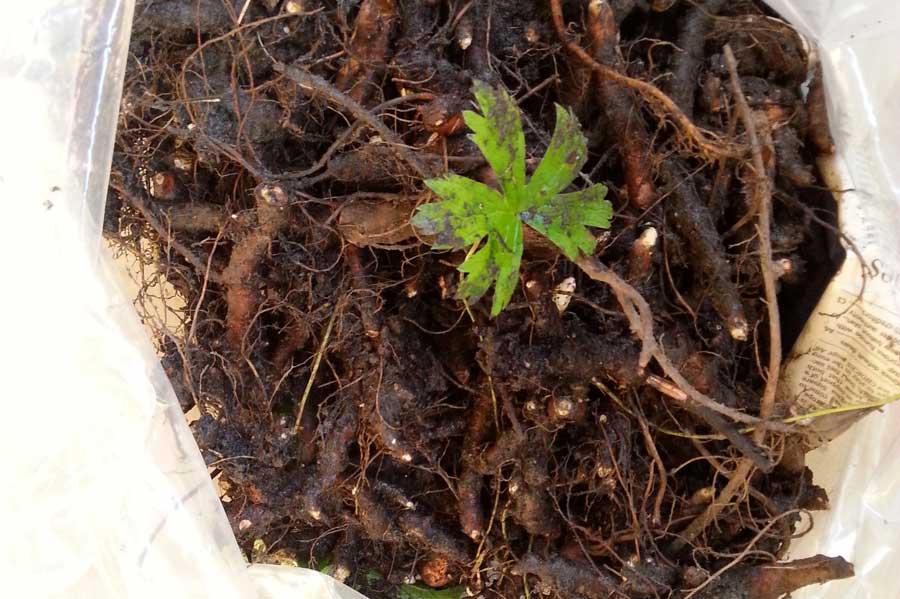
The Wild Geraniums are superbly robust and accept an amazingly wide spectrum of growing conditions. They are also one of the native species that sprinkle a beautiful touch of color across your rain garden in spring. But that is not the end of it! They rise to notoriety again in fall when their foliage turns a beautiful red. In short, Geranium maculatum is a good and reliable performer.

My last step was to plant the structural perennials. Well, those that were still missing. Last fall I planted the Amsonia hubrichtii (Blue Star) and Baptisia australis (Blue Wild Indigo). Those still missing were:
- Silphium terebinthinaceum (Prairie Dock),
- Panicum virgatum ‘Shenandoah’ (Switchgrass),
- Symphyotrichum novae-angliae ‘Purple Dome’ (New England Aster).
These I did not grow myself, but rather purchased them from local nurseries. And I purchased them in one gallon sized containers to give them a little head start in the competition with the sedges.