When you work with concrete, you have one chance to get it right. That left me with some frayed nerves from the work on the back porch footings and foundation wall. Even though everything turned out exceptionally well in the past (if I ignored my sprained ankle), I was interested in having someone pour the back porch concrete floor for me.
The pour itself didn’t worry me too much. But the finishing work did.
I had the chance to watch the pros when we installed the concrete floor in the basement. They had a large bull float, a trowelling machine and some skills. That made for a concrete floor with a nice finish.

The back porch floor was too small for a trowelling machine, and it was to small to get any of the pros interested in the job. So it landed back in my lap after all. And once again, I dug out a fence post and had a concrete truck sitting in our back yard.
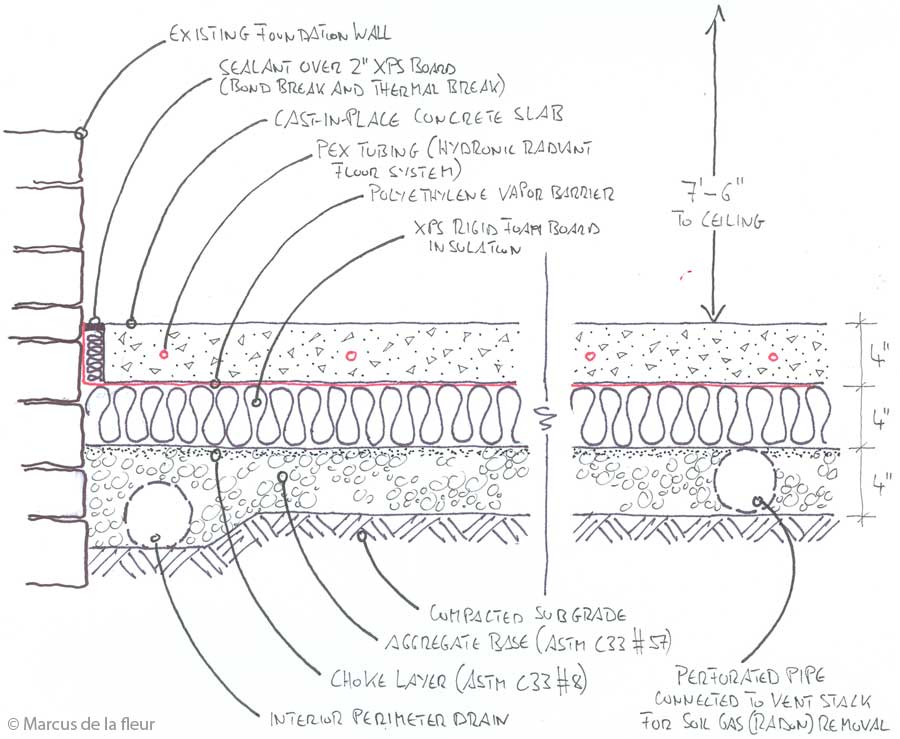
Pouring the concrete to the right elevation was fairly straight forward. The top edge of the bond break served as a guide for a two by four, which we used to screen the surface. I also got myself a wood float which I used to get the initial finish.
Once the concrete started to set, I used a magnesium float to refine the finish. I did that twice, each time letting the concrete cure some more. The finishing touch or last pass required a steel float or trowel. It allowed me to completely smooth out the surface paste. Not as easy as with a troweling machine, but I managed.
Last but not least, I removed the plugs I put proactively into the two floor drains and checked the slopes. Let’s say it was a very happy ending to this long day!
What I did different…
…this time around were a number of things, all based on my reflection after we had poured the basement floor a few years ago.
I used sturdy zip ties to attach the PEX tubing to the welded wire mesh … zip ties that were hard to break.

I didn’t fold the polyethylene sheet over the bond break, but taped it to the edge. That gave me a much cleaner finish around the margins.
I did not use a concrete vibrator, as I concluded I should have a few years ago. But I made sure that the concrete got into all nooks and crevices around the edges during the pour.
And I was careful about how I staged and sequenced the pour so that I could access any part of the freshly poured floor as needed for the trowelling.