Tag Archives: house hunting

Our kind of Realtor…

We are first time buyers – very nervous first time buyers. To put our minds at ease we did a lot of research, as you may have gathered from previous postings. That research included specifics on the house buying process. There are only a few books in the real estate section of our local library that we have not touched!

It is really interesting reading through some of the publications, given the recent collapse of the housing market. Most books focused on how to get rich buying a house, or the best way to buy it, fix it and flip it. The longest you will live in your purchase is five years, after which you sell and “move up” – if you believe what the books say. Of course, this sort of material is somewhat outdated.

Needless to say that this is not the approach we want to take.  We’re keen on buying a foreclosure, fixing it up and living in it as our primary residence for years to come.  Buying a foreclosure bears little resemblance to buying your typical house, as mentioned in the 04/04/2009 post.

Just trying to wrap our head around all this raised our stress levels. We needed help. We needed to find ourselves a Realtor – a good Realtor who can hold our hand in the purchasing process – someone who understands our very unusual goals and objectives.

We understand that our expectations run counter to those of most if not all average clients. Can we find a Realtor who is able to listen, put himself or herself into our shoes and think out of the box? We were not sure, and after working with a couple of Realtors whom we respected but who simply weren’t a good fit, we were even less sure.

Word to mouth is one of the more reliable research tools. We finally got a recommendation for a Realtor from our friend John. Michael Salvatori was willing and eager to take on the challenge. We very quickly learned to our delight that Michael was not only familiar with the neighborhood we wanted to investigate, but was very quick to understand what we were looking for.  He immediately forwarded us a great number of relevant listings, each an opportunity in its own rights.

A Realtor makes his or her living through commissions on the sales price. The commission is typically covered by the seller. The higher the sales price, the better the commission. The less time the Realtor has to put into a sale, the higher his return.

We are likely to purchase a foreclosure, probably for less than $100,000. This has “small commission” written all over it. Not only that, but the time a Realtor has to put into a foreclosure purchase can be quite significant, as it is not very easy to deal with the banks or entities that own or manage the foreclosure.

Michael did not blink once with the prospect of working on a foreclosure purchase or the probable run-around with the banks and/or seller. He stood with us all the time, and provided excellent services, advise and priceless expertise, which is priceless indeed for first time buyers like us! Thank you Michael.

If you’re looking to buy a house in Chicagoland, especially a big expensive house, and you think Michael is your kind of Realtor, you can find him at: www.coldwellbankeronline.com/michaelsalvatori

E-mail him at: [email protected]

Or call him at: (630) 373-2767
Price drop with catch

Remember that two-flat where we had the trouble determining the actual lot size (see 04/04/2009 post)?   While we were still pursuing it we’d received a call from the owner’s representative asking for our “final and best offer.” We were told at the time that they were giving us one more opportunity to adjust our bid because the seller had four other offers on the property. Once we withdrew our offer, we noticed that the property was promptly put back on the market. So much for the four other offers…

We kept monitoring the two-flat because we could not really find any comparables – and because we could not really put it out of our heads or hearts. Furthermore, we had been house hunting for close to a year and got increasingly anxious to buy.

Fast forward three months: Our two flat is listed with a huge price drop, of a whopping $35,000 – from the original $105,000 asking price down to $75,000. We were worried that this would be again one of those too good to be true situations. And I am sad to report that it was!

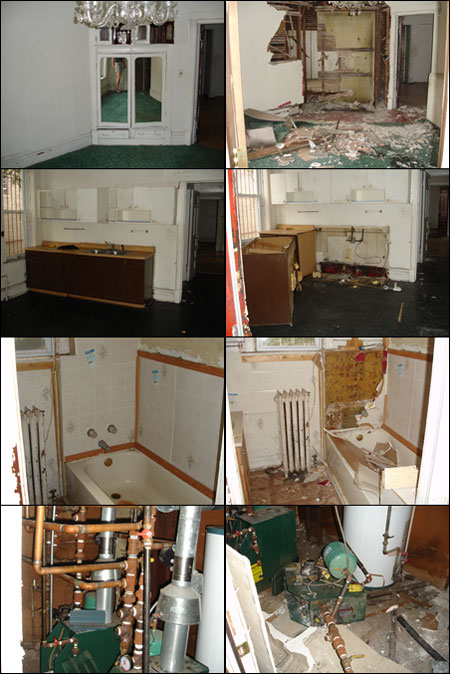
We went back to the property to take another look. My heart dropped to the floor when I walked up the front steps and saw through the window plaster and lath lying on the floor. Remember, this place needed a serious clean up, but was otherwise completely intact, including the heating system.

The old hutch in the living room was ripped out of the wall, probably to retrieve the lead from the stained glass doors. Some of the copper piping in that bathrooms and kitchens was removed; some of the walls were ripped open. The two furnaces in the basement were still there, but most of the copper piping was gone. We don’t own the place, nor do we have an offer on it. And still, it felt very personal.

vandalism1

But here is the good news: We have seen much worse. The more we started looking the more surprised we were to see material left behind, and walls only partially open. This was not a finished job. We learned from the neighbors that the vandals – excuse me – thieves, were interrupted by a resident down the street who came home from night shift. She saw someone standing guard, and the guard saw her. The thieves took no chances and were gone when the police arrived a few minutes later.

Here is more good news: This is a case were the neighbors actually look out for a vacant foreclosure on their block and call the police if something looks or sounds suspicious. This is a very good thing, another sign that this is a neighborhood where we’d like to live.

And here is the best news ever: That same week, the copper market collapsed. Whoever got that material out of the two-flat could now only get pennies for what he/she could have previously sold for dollars.

After we recovered emotionally from this shock, we decided that we should put another offer down, despite the damage and despite the smaller lot size. This two-flat in this neighborhood for the price of $75,000 is not something we want to ignore. Which presented us with a new challenge: How can we make sure no one is coming back to finish the job?

Separating fiction from the fact

We found a two flat that caught our eye – a beautiful masonry building with very solid bones. It even had an intact heating system, bathrooms and kitchen! The appliances were missing, but that was it. The kicker was the extra large lot, listed at 50 by 150 feet.

We took one look at it and knew we had a jewel on our hands. Even though it was a foreclosure, the offer we submitted was a little higher than the asking price. We did not want to take any chances of not getting it.

Foreclosure listings are an interesting beast. It is safe to assume that any information in the listing is guesswork and that the seller’s agent probably never has set foot in – or even in front of – the building. Don’t trust any of the listing information (sometimes even not the picture of the building)! It is up to the buyer to do his or her homework. Walking through the building is absolutely essential to verify the number of units and rooms, room sizes and the basement. We also always measured the property to verify the size.

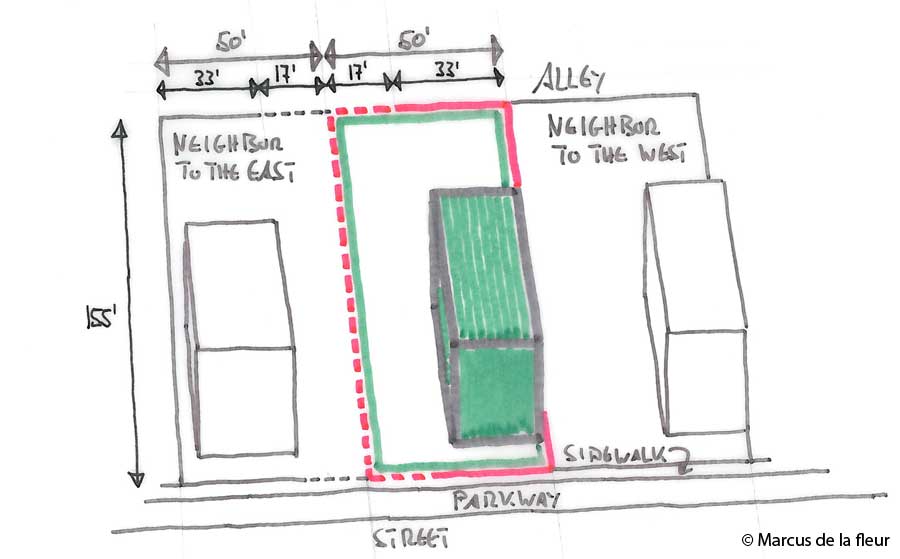
This is where it got really interesting. It appeared that this two flat had a 17 foot wide garden space along the east side, thus the 50 foot wide lot. The next building over had the same 17 foot wide garden space to its west side.

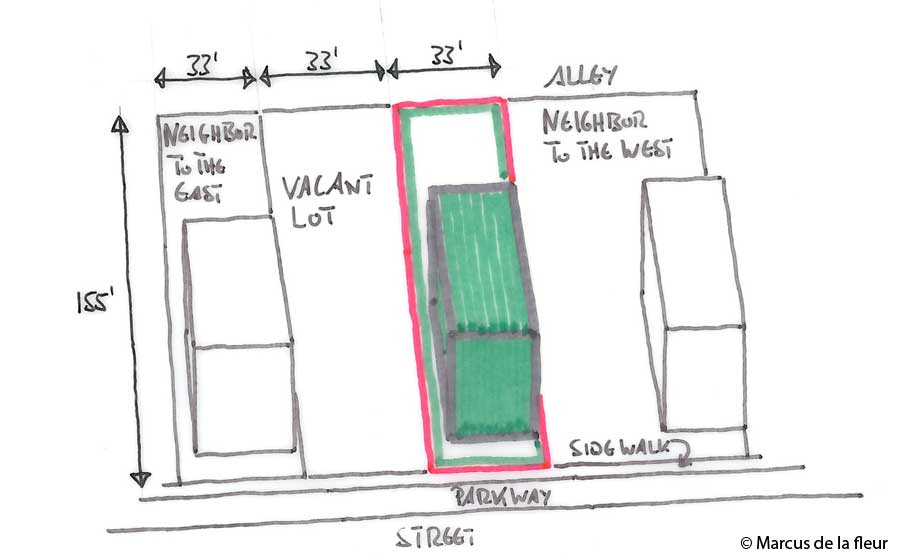
Or – the two adjacent 17 foot garden spaces were actually another, independently owned 33 foot wide vacant lot, as recent tax records suggested…

Our Realtor dug up some plat information, we talked to the neighbors, we researched old deed information at the City Hall archives, but we could not figure out what the actual property size was. Our attorney pointed out that a survey would give us a conclusive answer. Prior to the survey we will need to commission a title search that would include the actual legal description of the property. We decided to invest in the title search to begin with.

The survey became unnecessary once we had the legal description in hand. The description along with the plat information confirmed the information from the tax records. What the listing sold as extra garden space was in fact an independently owned vacant lot. The property size of the building was 33 by 155 feet and not 50 by 155 feet.

Well, if it sounds too good to be true, it probably is. Not only was this a big disappointment, but we withdrew our offer following the findings.

We learned quickly that the process of buying a foreclosure has very little in common with your typical property purchase, where the seller provides accurate information and covers the cost for items such as the title search and survey. Not so with foreclosures. The burden is on the buyer, and the buyer is well advised to take exercise due diligence in his or her research process.

Who will finance a foreclosure purchase?

We kept monitoring a number of foreclosures we earmarked – and witnessed the price tumble over time. I distinctly remember a beautiful large, sturdy, gray stone six flat, gutted on the inside, listed for $140,000. Imaging, that is $23,350 per unit! Very tempting, but too large of a building for us – we are first time buyers after all. The last time I checked the price was down to $75,000.

These buildings are on the market for very little money, but no one buys them. How can that be? Even if they need a lot of work, they are still a steal. Well, it’s not only the tons of tender loving care they need (see also 04/02/2009 posting), they are basically uninhabitable in their current condition.

Banks and mortgage lenders got very picky. They like to see a good credit history and a juicy down payment. The other thing they require is a property to be inhabitable before they finance the purchase. Inhabitable is defined as the property having a functioning bathroom and kitchen with running water and electricity. We looked at about 25 vacant foreclosures and none of them met that requirement.

We heard wild tales of buyers investing several hundred or even a thousand dollars into a property prior to closing, fixing up the bathroom and kitchen so they could secure financing. And even then there was no guarantee that the deal would go through. Too much of a déjà vu for us after our recent attempts to purchase a vacant city lot.

And honestly, not inhabitable is good for us, as we will remodel everything green anyway. Except – how are we going to finance the purchase and the rehab? I heard on National Public Radio that a lot of foreclosures are bought for cash. That is fine if you’re a builder with a cash flow, or if the property requires no major work. But that is not our world.

The solution to our problem fell into our lap during a beat meeting. Two representatives from a local community bank, ShoreBank, attended the meeting to spread the word about their Rescue Loan Program for homeowners at risk of foreclosure. We’d researched and talked with a lot of lenders, but ShoreBank was new to us.

A brief conversation after the beat meeting led to an appointment in which we learned about ShoreBank’s Rehabber Loans program. The bank’s mission is to invest in communities on Chicago’s South and West Sides, provide financing to improve housing stock, increase home ownership and offer special products for first time buyers.

Bingo! ShoreBank’s product appears to be a perfect match for our purchasing and rehab plans! The interest rate on the rehab loan seems a little higher than on other conventional mortgages, but at least ShoreBank is willing and interested in investing in the rehab, even if the subject property is uninhabitable as it is now.

The tale of vacant foreclosures…

Do we really want to touch a foreclosure? We have some reservations, not the least of which is imagining the hardship of the owners losing their home – their primary residence. Well, we found that the story is often not quite as clear cut: Almost all foreclosures we looked at were investment properties, bought during the housing bubble with the intent to flip.

We found them in various shapes and stages of remodeling. Some were almost completely gutted or had some remodeling work in the process, while others where almost completely renovated. We like the properties where almost all the interior demolition work had been complete, saving us that step in the rehab process.

We never know who we will meet when we get into those buildings with our Realtor. Some folks sought shelter in vacant foreclosures. There was frequent evidence of prostitution activity, drug activity, even drug production or stretching.

Very often we run into what we call the war zone: vacant, foreclosed properties that are not secured or are insufficiently secured. Scavengers have left their mark in every single building, with walls brutally ripped open to retrieve any copper piping or wiring. The mechanical equipment and appliances are often all stolen, cabinets and radiators removed… in short, the buildings are usually stripped of anything that has some resale value. In really bad cases we’ve found fire damage, whether it was arson or a squatter trying to stay warm.

One property left a distinct mark on us. The house was absolutely full of stuff – clothing, personal items and belongings, ripped off the shelves and out of the cabinets, piled on the floor 6 inches to 3 feet deep, on the first floor, second floor, and even worse in the basement. We had to climb over piles to get through the building. I remember photographs of a happy family on a summer day spread across the piles on the floor. It felt like whoever lived in that building had five to 15 minutes to gather their stuff and get out… It was eerie beyond words.