Tag Archives: mortgage

Interpreting ball park estimates

First, let’s look at some basic project budget principles: The total loan amount cannot exceed the projected appraised value of the property, once the renovations are complete. That appraisal takes into account all of our planned improvements to the house (see also 04/12/2009 post) and came in at $280,000.

If we subtract the purchasing price of $60,000, we are left with $220,000, which is the maximum amount that our bank (ShoreBank) would lend us for the green rehab.

Cathy and I feel that $220,000 for the rehab is more than we want to take on right now. We went through our personal finances with a fine tooth comb, looked at various mortgage scenarios, estimated monthly payments, and decided that we can manage a rehab loan amount of $160,000 right now.

This $160,000 is one piece of the puzzle. I now have to get the other piece – what that $160,000 is actually buying us. We have a number of ball park estimates from contractors and vendors (see also 05/13/2009 post), which are all very conservative, because of the limited information I could provide at the time I requested the information.

How would I know that these estimates are conservative? By talking to friends, industry contacts and other homeowners who actually had, for example, a base board heating system installed. Their project may be different from ours, but the aggregate pricing information gives us the clues.

scope-and-pricing

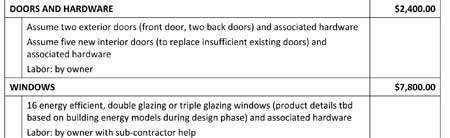
In short, our project budget (see also: 3141 ball park project budget) is based our interpretation of the conservative estimates we received. It is a product of our combined guesstimates, leaving a lot of questions unanswered, such as how the work we plan to complete ourselves impacts the budget.

We hope to completely rehab the basement and 1st floor for the $160,000. What can we really get for that money? Your guess is as good as ours, and you can witness this unfolding over the next few months on this blog.

Cost shock management – developing a budget

In order to develop a somewhat reliable project budget, we need a real property, which we now have (finally). I mentioned in the 04/12/2009 post our efforts to put a rehab budget together. Let’s look at this process in some more detail.

  1. Fact: Our total loan amount for the sustainable project includes the purchase price of the property plus the money for the green rehab.
  2. To pursue any meaningful budget exercise, we needed a basic plan for our green rehab ideas. Our project principles and rationales provided that framework.
  3. We shared this information with vendors and contractors and arranged for meetings at the property to discuss the project, its various components and the associated work in more detail.
  4. After we shared this basic information with vendors and contractors, we solicited initial ballpark estimates. These estimates became the foundation for our rehab budget.

The tricky part in all this is that we have no final design or engineering. In other words, some of our assumptions may have to change down the road. Those are the same assumptions on which the contractors and vendors based their estimates, which we in turn used to as the foundation for the budget development. Sounds like a house of cards, doesn’t it?

Why would some assumptions change? Well, this is an old house, and we don’t have a full inventory of the building. Electrical, plumbing and heating will most likely need to be completely rebuilt. But we can’t look into the walls to see what other problems, if any, are lurking there waiting to be discovered – such as structural damage (God forbid).

I owe an apology to all vendors and contractors that were kind enough to issue their estimates. I did to them what I do not like having done to myself in my capacity as a landscape architect. And that is to answer the question of “what does the project cost,” based on very little research and very vague parameters. You typically can’t win in these situations, and risk an unhappy client because the budget will change with every piece of new information that rolls in.

The contractors and vendors have my sympathy and my gratitude for working with the limited information I had at the time.  The exercise wasn’t fruitless because we got to meet and talk about the project. The vendors and contractors extracted more details on our plans and expectations, while we were able to evaluate a potential working relationship.

I don’t plan to hold the vendors and contractors to their estimates, but use the numbers to the development of the initial project budget – something that I still need to complete.

Buying a foreclosure – Part 7

We have read a lot and had numerous discussions with friends who have bought houses. Everybody has a story how something goes astray last minute. We are no exception – and just in case you are interested – here is our account of how our resolve got tested:

3 days to closing

We really need to get the mortgage commitment letter from ShoreBank so that we can formally schedule the closing that has been set for this Thursday (see also 04/13/2009 post). I started to poke around and finally found out that nothing is moving or happening because ShoreBank had no proof of insurance and no loan approval.

What?!

Didn’t I just send our proof of insurance (see also 04/13/2009 post)? It turns out that the preparation of closing documents is passed from Phil (our banker) to a different person (Pat) in a different ShoreBank branch office. Resolving the proof of insurance issue is easy: I just e-mailed Pat the documents.

2 days to closing

I receive an e-mail from Joe Ziccardi (our attorney) that the proof of insurance has to be re-issued. ShoreBank needs us to change the mortgagee information on the document and also a copy of the receipt as proof of payment. I scrambled to get the insurance broker to re-issue our proof of insurance and e-mailed it with receipt of payment to ShoreBank.

29 hours to closing

The loan approval is still missing! I am back on the phone to find out that it got somewhere stuck in the transfer from Phil to Pat. The seller told us in no uncertain terms that closing would not be delayed again and we are still fussing around with a critical document lost in transit. Phil was very apologetic and went personally after the documents to make sure they arrived at Pat’s desk. Finally, the mortgage commitment letter went out.

25 hours to closing

We receive good news from Joe . We have our closing scheduled, with confirmed location and time. We will still close on Thursday – hurray, no further delays!

20 hours to closing

We stop by the two-flat to have a last look before we purchase it. Everything seems normal until I notice that the front basement door is not closed. The locks are busted! Thanks God I have the tool bucket in the car. Cathy and I are able to barricade the door and have the property secured again. Not how we wanted to spend the evening.
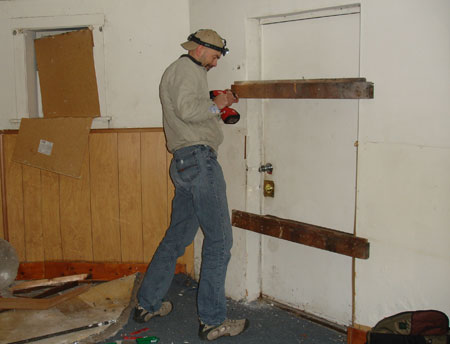
basement-door-board-up

16 hours to closing

Back home, we had the HUD-1 settlement statement and other paperwork in our inbox for us to review. We e-mailed a couple of questions to Joe.

What is a HUD-1?  (HUD – U.S. Department of Housing and Urban Development)

“The HUD-1 Settlement Statement is a standard form which is used to itemize services and fees charged to the borrower by the lender or broker. The borrower has the right to inspect the HUD-1 one day prior or day of settlement. The form is filled out by the settlement agent who will conduct the settlement. Borrowers may compare their Good Faith Estimate to the HUD-1 Settlement Statement and ask their lender or broker about any changes.”

Source: Wikipedia
Other resources: HUD1 Settlement Statement form

14 hours to closing

I had a few beers to calm me down, and am pleased to report that this proceeded without any delay or glitches – which was very refreshing indeed.

7 hours to closing

We got a prompt, first thing in the morning and straight forward response from Joe on our HUD-1 questions. This is what we love about Joe: very responsive, extremely reliable, and really good at explaining things.

2 hours to closing

Michael (our Realtor) called: The seller’s Realtor does not have the earnest money! Well, we are confident that they received the earnest money, but probably misplaced it – which would fall right into the pattern they displayed in the past (see also 04/08/2009 post).

OK, let’s assume that, for whatever reason, they did not receive the earnest money. Why on earth are they noticing 2 hours prior to the closing? I can’t believe they are still in business, operating like this…

We resolved the issue by agreeing to bring another cashier’s check to the closing table to cover the missing earnest money.

1 hour and 30 minutes to closing

Cathy is back from the bank with the earnest money cashier’s check. She also made sure to stop payment on the original earnest money check.

1 hour prior to closing

Departure to the title company office for the closing.

At closing

I have to say that I had imaged the pile of paper we needed to sign to be much more intimidating and big. It was not that bad at all. There was not one document that we did not expect or did not know about.

In addition to that, Joe did an excellent job walking us through every document, explaining it, and making sure we understood the legal jargon and knew what we were signing. We also took our time in reading through some of the less familiar documents.

1 hour and 30 minutes into the closing

S. O.  L.! Because of the missing earnest money check and having to replace it with a cashier’s check, our HUD-1 has changed: the line item for the earnest money needed to be removed to reflect the fact that we were now bringing it to the closing table. To finish the closing process, everybody has to sign the new HUD-1, including the bank that owns the property – that bank that has been so unbelievably elusive. “May be we’ll hear back from them today, if not hopefully tomorrow…”

We have to leave the closing table without completing the deal, without any keys. Actually, there were no keys anyway. The seller’s Realtor, who misplaced or lost our earnest money check, did not show at the closing. So we will have to go to the property and retrieve the key from the lock box – once we have the signed HUD-1 back from the seller… Can it get any more anticlimactic that this?

Related posts:
Buying a foreclosure – Part 6

Will our loan application be approved? (see also 04/12/2009 post) Next Thursday’s loan board meeting by ShoreBank was still a few days out. I decided to use the time effectively and get the mandatory homeowners insurance.

I’d met with our existing insurance agent at the two-flat for an inspection and to get the home owners insurance process started. Our agent was very polite and diplomatic. He did not laugh at us when he saw the property, but informed us that it is very unlikely that we would get conventional homeowners insurance, considering the conditions this property was in.

He referred us to another broker that specializes in policies for vacant dwellings, a policy that is often used by builders and developers for their properties that are under construction. We got quotes and shared the details with ShoreBank to make sure the policy would meet their requirements.

We can buy vacant-dwelling insurance for three-month terms. This kind of policy is a little more expensive than your typical home owners insurance. Our hope is that we renew once. We would like to be far enough along in the green rehabbing process after six months to switch to a regular homeowners insurance policy.

I prepared the policy application, took it to the broker’s office to get the last details ironed out, paid for the policy and left with the magic ‘proof of insurance’ in my hand. I forwarded the document immediately to Joe Ziccardi (our attorney) and ShoreBank.

The magic Thursday, the day of our loan application review, came along and we received a phone call from Phil (our banker) that our application was approved. So we passed another milestone and are one step closer to closing.

To schedule the closing, the seller requires a written mortgage commitment from ShoreBank (our lender).

Mortgage Commitment: “Written confirmation from a buyer’s bank to a seller of a property that the bank will advance the specified sums (usually as a mortgage loan) enabling the buyer to complete the purchase.”

Source: BusinessDictionary.com

We need to get that commitment, and we need to get it fast, because closing is next Thursday – in 6 days already!

Related posts:

Buying a foreclosure – Part 5

Time is ticking away and we are trying to get a handle on what has to be put together, and when. Not an easy process if you are a first-time buyer. We finally (sort of) got a schedule from ShoreBank:

  1. Determine project budget
  2. Commission appraisal of property
  3. Take loan application to ShoreBank’s loan board for approval

Project budget

I scramble to put a budget for our green rehab together. We need to determine how much money is going into the green rehab to set the total loan amount (purchase price + rehab budget).

Fortunately we have our project rationales and principles in place to guide us through this process. We shared this information with developers, green building experts and friends that had rehabbing experience and could help us with our project budget development. We also contacted various specialists (such as energy experts), vendors (such as solar hot water), and contractors for pricing information.

Appraisal

Once we have the budget number, there is no guarantee that ShoreBank will lend us that much. The upper limit of the loan amount is determined by two factors. The first one – how much we feel we can take on – is controlled by us. The second is determined by an appraisal commissioned by ShoreBank. This appraisal takes into account all of our planned improvements to the house – it is a post-improvement appraisal.

Our worry is that the dollar amount of the post-improvement appraisal will be lower than our project budget. That would through a big old wrench into the process. We would need to conduct more pricing research to figure out how to cut our budget with the closing date fast approaching.

To get to the appraisal commissioned, ShoreBank was pressing for our project budget and I was able to deliver half a day early. That did not help us. It turned out that the appraisal would take longer than usual due to the sustainable scope of our rehab plans and the associated extra research.

Loan approval

ShoreBank’s loan board in Chicago currently meets once a week (every Thursday) to review and approve loan applications. Phil (our banker) worked hard on getting our application in front of the board as soon as possible. He needed the appraisal on Wednesday for the Thursday’s meeting. But unfortunately the appraisal arrived on Thursday and we missed this week’s opportunity to have our application reviewed.

The bad news is that this set us back a whole week to next Thursday. That is the same Thursday on which our closing should have taken place! The good news is that the appraisal was actually higher than our requested loan amount.

We now have to worry about pushing the closing date back again. We were not sure if the seller would just cancel the deal or go along with another extension. This is where we could rely as usual on Joe Ziccardi (our attorney). He managed once again to have the seller agree to the new closing date and to have any penalties for the delay waived. Thank you Joe!

We coordinated with ShoreBank to make sure that the new closing date was realistic: The seller had insisted that this was the last and final extension granted.

Related posts: