Tag Archives: realtor

Buying a foreclosure – Part 7

We have read a lot and had numerous discussions with friends who have bought houses. Everybody has a story how something goes astray last minute. We are no exception – and just in case you are interested – here is our account of how our resolve got tested:

3 days to closing

We really need to get the mortgage commitment letter from ShoreBank so that we can formally schedule the closing that has been set for this Thursday (see also 04/13/2009 post). I started to poke around and finally found out that nothing is moving or happening because ShoreBank had no proof of insurance and no loan approval.

What?!

Didn’t I just send our proof of insurance (see also 04/13/2009 post)? It turns out that the preparation of closing documents is passed from Phil (our banker) to a different person (Pat) in a different ShoreBank branch office. Resolving the proof of insurance issue is easy: I just e-mailed Pat the documents.

2 days to closing

I receive an e-mail from Joe Ziccardi (our attorney) that the proof of insurance has to be re-issued. ShoreBank needs us to change the mortgagee information on the document and also a copy of the receipt as proof of payment. I scrambled to get the insurance broker to re-issue our proof of insurance and e-mailed it with receipt of payment to ShoreBank.

29 hours to closing

The loan approval is still missing! I am back on the phone to find out that it got somewhere stuck in the transfer from Phil to Pat. The seller told us in no uncertain terms that closing would not be delayed again and we are still fussing around with a critical document lost in transit. Phil was very apologetic and went personally after the documents to make sure they arrived at Pat’s desk. Finally, the mortgage commitment letter went out.

25 hours to closing

We receive good news from Joe . We have our closing scheduled, with confirmed location and time. We will still close on Thursday – hurray, no further delays!

20 hours to closing

We stop by the two-flat to have a last look before we purchase it. Everything seems normal until I notice that the front basement door is not closed. The locks are busted! Thanks God I have the tool bucket in the car. Cathy and I are able to barricade the door and have the property secured again. Not how we wanted to spend the evening.
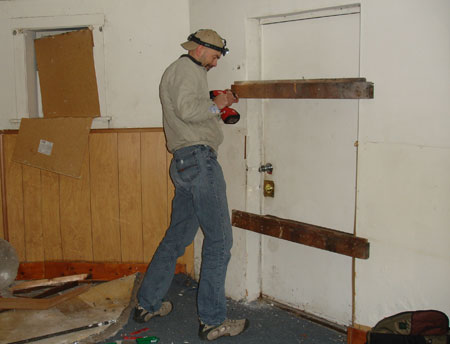
basement-door-board-up

16 hours to closing

Back home, we had the HUD-1 settlement statement and other paperwork in our inbox for us to review. We e-mailed a couple of questions to Joe.

What is a HUD-1?  (HUD – U.S. Department of Housing and Urban Development)

“The HUD-1 Settlement Statement is a standard form which is used to itemize services and fees charged to the borrower by the lender or broker. The borrower has the right to inspect the HUD-1 one day prior or day of settlement. The form is filled out by the settlement agent who will conduct the settlement. Borrowers may compare their Good Faith Estimate to the HUD-1 Settlement Statement and ask their lender or broker about any changes.”

Source: Wikipedia
Other resources: HUD1 Settlement Statement form

14 hours to closing

I had a few beers to calm me down, and am pleased to report that this proceeded without any delay or glitches – which was very refreshing indeed.

7 hours to closing

We got a prompt, first thing in the morning and straight forward response from Joe on our HUD-1 questions. This is what we love about Joe: very responsive, extremely reliable, and really good at explaining things.

2 hours to closing

Michael (our Realtor) called: The seller’s Realtor does not have the earnest money! Well, we are confident that they received the earnest money, but probably misplaced it – which would fall right into the pattern they displayed in the past (see also 04/08/2009 post).

OK, let’s assume that, for whatever reason, they did not receive the earnest money. Why on earth are they noticing 2 hours prior to the closing? I can’t believe they are still in business, operating like this…

We resolved the issue by agreeing to bring another cashier’s check to the closing table to cover the missing earnest money.

1 hour and 30 minutes to closing

Cathy is back from the bank with the earnest money cashier’s check. She also made sure to stop payment on the original earnest money check.

1 hour prior to closing

Departure to the title company office for the closing.

At closing

I have to say that I had imaged the pile of paper we needed to sign to be much more intimidating and big. It was not that bad at all. There was not one document that we did not expect or did not know about.

In addition to that, Joe did an excellent job walking us through every document, explaining it, and making sure we understood the legal jargon and knew what we were signing. We also took our time in reading through some of the less familiar documents.

1 hour and 30 minutes into the closing

S. O.  L.! Because of the missing earnest money check and having to replace it with a cashier’s check, our HUD-1 has changed: the line item for the earnest money needed to be removed to reflect the fact that we were now bringing it to the closing table. To finish the closing process, everybody has to sign the new HUD-1, including the bank that owns the property – that bank that has been so unbelievably elusive. “May be we’ll hear back from them today, if not hopefully tomorrow…”

We have to leave the closing table without completing the deal, without any keys. Actually, there were no keys anyway. The seller’s Realtor, who misplaced or lost our earnest money check, did not show at the closing. So we will have to go to the property and retrieve the key from the lock box – once we have the signed HUD-1 back from the seller… Can it get any more anticlimactic that this?
Related posts:

Buying a foreclosure – Part 3

We are happy about the recent price drop for what we started calling “our two-flat” and submitted a new offer for the $60,000 asking price. This time around, things happened at the speed of light. Not only did we get the usual verbal confirmation of the offer acceptance, we actually got the sellers counter offer and addendum within days!

Seller’s counter offer and addendum

What is a seller’s counter offer and addendum? We initially submitted with the help of Michael (our Realtor) a standard Chicago Real Estate contract with a preapproval letter from a lender and a copy of our earnest money check. That package is basically our offer. If the seller accepts our offer, they issue their own contract, comprised of a counter offer and an addendum. Most people think of a counter offer as being related to the price of the property, but this negotiation has nothing to do with the price, which is set.  The counter offer has to do with the seller’s contract, which absolutely supersedes our original contract, except for those terms that are not inconsistent with the sellers counter offer and addendum. Got it? To figure out what supersedes what, some careful reading is required.

Response to counter offer and addendum

That is exactly what we did and identified a number of items that were inconsistent, did not make sense, or that we disagreed with. Our attorney, Joe Ziccardi, summarized those items in a response to the seller, basically requesting changes to the counter offer and addendum.

Ratified and executed agreement

Only a couple of days later (yes – things suddenly started to move fast!) we got the fully ratified and executed agreement. This basically means that our response or request for changes to the counter offer and addendum were accepted and all parties are in agreement on the terms. It was almost too good to be true… except that it the “fully ratified and executed agreement” had no reference to our response and request for a few changes to the counter offer, and did not even acknowledge  receipt of our request.

The reference finally arrived a few days later from the seller’s attorney, with six out of our seven request for changes declined. Initially, we were not sure what to make of it, but began to realize that these items could be resolved through negotiation or a request of clarification. The problem is that like with the seller’s agent, the seller’s attorney was not very responsive. Thanks to the persistence of our attorney, he finally reached a warm body picking up the phone and worked his way to the person who dealt with our case. Not only that, but Joe was able to get clarification on all the questions and disagreements we had. A few more days of nail biting and we were finally in possession of a truly ratified and executed agreement – hooray!

We now were also finally able to secure the building by boarding up the back porch windows. You have no idea how much weight this took of our shoulders!  (Especially after we got down off the ladder after holding ¾” sheets of plywood up there in the rain while we secured them.)

back-porch-boarded-up

Related posts:

Buying a foreclosure – Part 2

One might think that a bank that owns a foreclosure would like to sell it quickly to take it off the books. Our experience so far has been the opposite, after two of our offers, both for just a little more than the asking price of $75,000, were canceled for no good reason.

When Michael, our Realtor, got word of the second cancellation, both Cathy and I were out of town on work trips – and both were incommunicado. This is where a good Realtor is priceless. Michael knew what we wanted and immediately resubmitted the offer again on our behalf. Thank you Michael!

And this is where it got unreal: While preparing the offer for re-submittal, Michael found out that the asking price had dropped by another whopping $15,000, down to $60,000 – because the bank was unable to unload property! Never mind that we offered twice to buy it for $75,000. But who are we to complain. We started joking that if we kept re-submitting often enough, the seller may give us money if we take the property.

That said, we were unsure what to make of this price drop. Suspicion crept in. Like my dad said when we told him the story: “That can’t be right! Since when is a bank giving away money – and as much as $15,000?” Is this another instance of too good to be true?

We went back into research mode. There was no further damage to the property – thank God. We found out which bank actually owns the foreclosure, and got a better understanding of the convoluted paper pushing process. It turns out that the seller’s agent never really talks to a person on the bank’s side. They just input data into an online system, which is received at the bank and “processed”. This could happen in any office of that bank, of which there are numerous nationwide. It appears there is no one person assigned to a case.

You hear a lot about the banks not being ready for this growing wave of foreclosures. We got the impression that the left hand did not know what the right hand was doing – or that there even was a right hand. Understanding this, we felt more at ease with the price drop and that it actually was for real.

Related posts:

Buying a foreclosure – Part 1

Now that we put another offer down on the foreclosed two-flat we like so much, we have an interest in having the property secured (see also 04/06/2009 post). Vacant, unsecured buildings (often foreclosures) are a big problem for the City of Chicago. They invite illegal activities such as prostitution, drug dealing and drug manufacturing, and often become a safety and fire risk. The city takes this very serious and has an abandoned building program where such nuisance properties can be reported.

back-porch-no-window

The back porch windows at our two-flat are knocked out and relatively easy to climb through. Michael Salvatori, our Realtor, contacted the seller’s agent and was told they can do nothing to secure the property. We learned that the seller’s agent had literally hundreds of foreclosures to deal with and was completely overwhelmed. Never mind that the seller does not want to spend any money on the property…

We decided that we’d have to take it upon ourselves to secure the property. That said, we have to wait until we have an executed and ratified agreement:

  1. We did not want to run the risk of trespassing.
  2. We did not want to invest in securing the building without some certainty that we actually get it.

What happened next is what we call the dance:

  1. Michael received a phone call informing him that our offer was accepted.
  2. Excellent – until the next phone call came, asking for our final and best offer. This had déjà vu written all over it (see also 04/06/2009 post).
  3. We were confident that this was just standard protocol by the seller and raised the offer by a few hundred dollars to show our good intent,
  4. Upon which Michael received another verbal confirmation that our offer was accepted.
  5. All we need now is the paperwork, the executed contract.

We waited and got more and more nervous because we were about to leave for a two-week vacation. We were  still waiting as we packed and went to the airport. We waited while we were gone, and we returned and waited some more. Finally, one day prior to the proposed closing date, Michael was able to reach the seller’s agent, only to learn that our deal got canceled! Why? Your guess is as good as ours.

We asked, “Can we submit the offer again?” The answer was yes and Michael wasted no time doing so on our behalf. And we started the dance again:

  1. Michael received a verbal confirmation of acceptance
  2. We received another request for our final and best offer
  3. We raised the price by a few hundred dollars
  4. Michael received another verbal confirmation of acceptance
  5. And we started waiting again for the paperwork

Except, this time Michael received a phone call from the seller’s agent (I had given up to believe that this could actually happen), informing him that our deal was once more canceled! Still no real good reason as to why.

Does the bank, who has ownership of this property, really want to sell it? We constantly hear in the news how bad these foreclosures hurt the banks, and how desperately they would like to unload them. But we also hear that they have difficulties to keep up with all the paperwork. May be that is where we keep getting stuck with our purchasing attempts – in that huge pile of paperwork.

Our kind of Realtor…

We are first time buyers – very nervous first time buyers. To put our minds at ease we did a lot of research, as you may have gathered from previous postings. That research included specifics on the house buying process. There are only a few books in the real estate section of our local library that we have not touched!

It is really interesting reading through some of the publications, given the recent collapse of the housing market. Most books focused on how to get rich buying a house, or the best way to buy it, fix it and flip it. The longest you will live in your purchase is five years, after which you sell and “move up” – if you believe what the books say. Of course, this sort of material is somewhat outdated.

Needless to say that this is not the approach we want to take.  We’re keen on buying a foreclosure, fixing it up and living in it as our primary residence for years to come.  Buying a foreclosure bears little resemblance to buying your typical house, as mentioned in the 04/04/2009 post.

Just trying to wrap our head around all this raised our stress levels. We needed help. We needed to find ourselves a Realtor – a good Realtor who can hold our hand in the purchasing process – someone who understands our very unusual goals and objectives.

We understand that our expectations run counter to those of most if not all average clients. Can we find a Realtor who is able to listen, put himself or herself into our shoes and think out of the box? We were not sure, and after working with a couple of Realtors whom we respected but who simply weren’t a good fit, we were even less sure.

Word to mouth is one of the more reliable research tools. We finally got a recommendation for a Realtor from our friend John. Michael Salvatori was willing and eager to take on the challenge. We very quickly learned to our delight that Michael was not only familiar with the neighborhood we wanted to investigate, but was very quick to understand what we were looking for.  He immediately forwarded us a great number of relevant listings, each an opportunity in its own rights.

A Realtor makes his or her living through commissions on the sales price. The commission is typically covered by the seller. The higher the sales price, the better the commission. The less time the Realtor has to put into a sale, the higher his return.

We are likely to purchase a foreclosure, probably for less than $100,000. This has “small commission” written all over it. Not only that, but the time a Realtor has to put into a foreclosure purchase can be quite significant, as it is not very easy to deal with the banks or entities that own or manage the foreclosure.

Michael did not blink once with the prospect of working on a foreclosure purchase or the probable run-around with the banks and/or seller. He stood with us all the time, and provided excellent services, advise and priceless expertise, which is priceless indeed for first time buyers like us! Thank you Michael.

If you’re looking to buy a house in Chicagoland, especially a big expensive house, and you think Michael is your kind of Realtor, you can find him at: www.coldwellbankeronline.com/michaelsalvatori

E-mail him at: [email protected]

Or call him at: (630) 373-2767