Part of our wish list is to have our vegetable garden on the roof. A feasibility study revealed that this would be possible without spending too much money or jumping through too many hoops.
Since then, we have worked our way through the basement and 1st floor, and along the way installed the required structural reinforcements.
I can now devote my time to get the 2nd floor and attic ready to safely hold up our future fresh produce supply.
The weakest link in supporting a green roof are the long roof joist spans across the 2nd floor kitchen and dining room.

To get this resolved, we need to call in some family support. In other words, the roof joists in the dining room need to be sistered on both sides, but only on one side in the kitchen, which makes it a slightly smaller family affair. The sistering of the joists increases the deflection strength to the required level.
The shear strength of the existing roof joists, which are pocketed into the existing masonry wall, is sufficient to support the additional load from the green roof. Except for a couple of joists, which are not pocketed at all.
Dining room
The center roof joist in the dining room stops about two feet short from the masonry wall. The joist terminated in a header that is connected to the two adjacent joists. Another short piece of joist bridges the missing two feet from the header into the masonry wall.
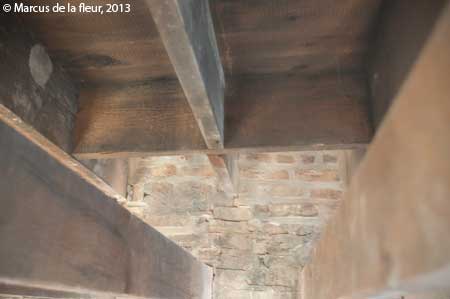
To sister the joists, I have to remove the header. That would leave the majority of the center joist floating without support. After consulting with our structural engineer, we decided that I will need to pocket the two sisters around the center joists into the masonry wall to provide adequate shear strength.
The engineer also determined that despite the the center joist stopping two feet short of the wall, once sistered, the assembly would provide the required deflection capacity.
Kitchen
Two of the roof joists in the kitchen also terminate into a header right at the old chimney.
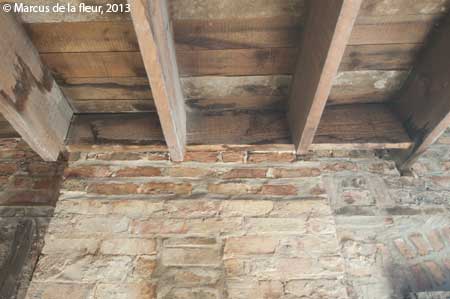
Because hot exhausts and wooden joists don’t mix, rather than pocketing them into the chimney, the original builders must have deemed this a safer way.
I again have to remove the header if I am to sister the roof joists to get to the required deflection capacity. With the chimney out of commission, I can now safely pocket the sisters into the masonry for the shear strength that the original joists don’t provide.
One of the supporting joists for the header is very badly notched.
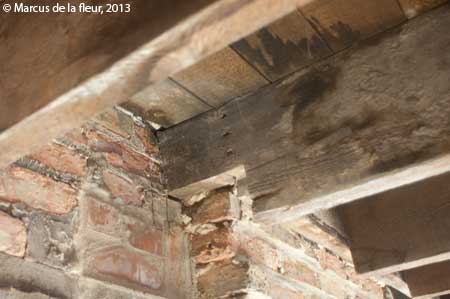
The structural engineer and I agreed that the shear strength left here is insufficient and that the sistering joist would need again to be pocketed into the masonry wall to make up for it.
That leaves me with quite a few pockets that I have to punch into the wall. While at it, I felt it wouldn’t harm to pocket most of the sistering joists and thus increase the shear strength. Not that it would be needed. But it makes for a better night’s sleep.
A sound bite of wisdom
As they say: “Kids – don’t try this at home!”.
Seriously, I have worked on a lot of green roofs in my career and can assure you that no one turns out the same. If you are contemplating a green roof, don’t make any assumptions on structural issues or load capacities. Don’t interpret or interpolate. Get a structural engineer involved! It will possibly be some of the safest money you ever spend.
Related posts:
Do you have a cost on what this green roof retrofit is costing you. I’d also be curious about how long before you would see the pay off on this project.
Thanks. Roberta