We need to structure our DWV system in a way that allows us to separate the blackwater from recyclable greywater. That requires scrutiny of all waste water sources in the building and to assign them to the one or the other category.
Discharge from the toilet contains human waste and as such is blackwater. This is easy.


But what about the kitchen sink and dishwasher? Waste water from these sources is typically considered greywater. We are, however, concerned about the contamination potential through food scraps.
To keep things simple and to have peace of mind, we made the decision to discharge waste water from the kitchen sources with the blackwater and not recycle it.
Drain water from the shower and bathtub, on the other hand, is a perfect source of recyclable greywater. So is the water from the bathroom sink, except that there will be very little of it considering our low flow faucets at 0.5 gpm.


Last but not least, there is the washing machine in the basement, the waste water from which is also a good greywater source.
Let’s see how the categorizing of these sources fits with or impacts the DWV layout.
Structuring the sewer
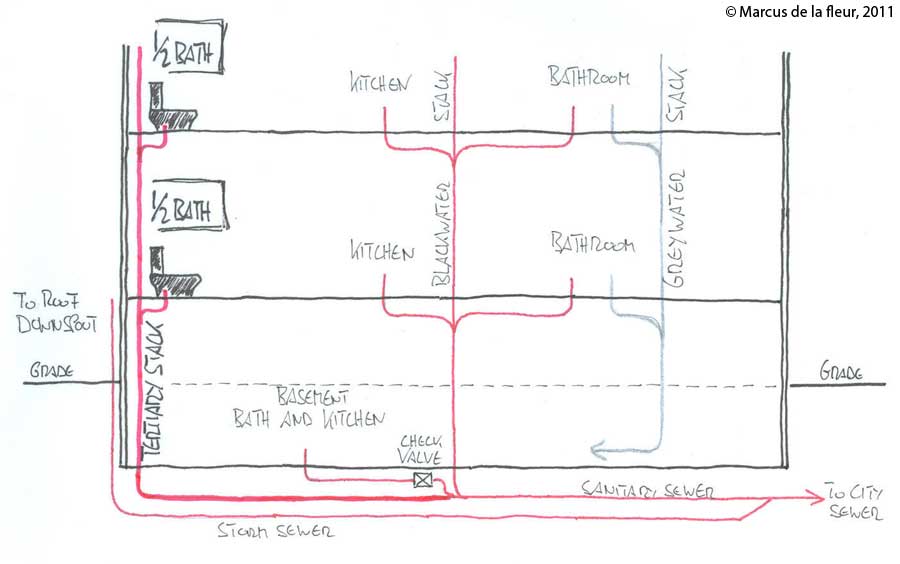
The entire basement DVW plumbing was dictated by flood prevention concerns. We solved the problem by separating the basement DWV from the other floors and protected it with a check valve.
This solution has one drawback. The layout prevents us from collecting or recycling greywater from the basement fixtures. (The exception is the washing machine.)
The basement DVW system as well as the upstairs bathroom layout determined the location of the main sewer stack (or blackwater stack) that will serve the 1st and 2nd floors. It will carry the waste water from the toilets, kitchen sinks and dishwashers.

The 1st and 2nd floor bathroom showers and floor drains are connected to a secondary stack, which is a dedicated greywater stack. Right now this secondary or greywater stack is connected to the basement DWV system to comply with the Chicago plumbing code.
However, once the collection and recycling of greywater becomes permissible, we will be ready for it. We can insert a small collection tank with a little sump pump at the bottom of the stack. The small collection tank would still have an emergency connection to the basement DWV plumbing (as is the case now) in case of a power outage of failure of the sump pump.
The sump would pump the geywater from the small collection tank to a gravity filter from where it would flow into the final storage tank.

That takes care of everything, except the waste water from the bathroom faucet, which is some distance from the greywater stack, but right next to the blackwater stack. We probably could figure out how to connect it to the greywater stack. But is it worth considering the faucet flow rate of 0.5 gpm and the miniscule amount of waste water produced?
We always could go with an off-the-shelf greywater system, which is installed under the sink and routes the filtered waste water into the adjacent toilet tank for flushing. That is, once these systems are permitted by the Chicago Plumbing Code.
The waste heat layer
This exercise got us to think about solutions for greywater recycling. But there is another waste product that we didn’t want to ignore: the waste heat in the greywater.
To recapture the waste heat we installed a drain water heat recovery (DWHR) system.
Going a few posts back you can read up on how we scrutinized the sources of waste heat, weather it comes from a greywater or blackwater source, and determined how it would impact the DWV layout.
We ended up placing the DWHR unit at the bottom of the greywater stack, just above the future collection tank.